
Whitepaper
A CTO's framework · June 2026 · 12-min read
Your agents are making architecture decisions. Who's governing them?
AI writes code faster than any team can review, and your architecture drifts just as fast. The Architecture Control Plane is the framework for governing the AI SDLC before the entropy compounds.

The one system of record every engineering org is missing
The four control surfaces you must govern in the agentic era
A 5-level maturity model, and where your org really ranks
🔒 No spam, ever
Instant download
12-page PDF

Read by engineering leaders governing AI-generated software.


Trusted by engineering leaders at
Gem
Certificate Hero
Just Appraised

"Coolest Tech"
Transform 2025
Why this matters now
The control has already moved.
Most orgs just haven't instrumented it.
Coding agents force-multiplied your developers, not the architects above them. The bottleneck moved upstream, and so did the risk.
40%
of enterprise apps
will include task-specific AI agents by 2026, up from under 5% in 2025.
Gartner, 2025
30-40%
of engineering effort
already goes to rework from drift and technical debt. At agent speed, it compounds faster.
Catio estimate
1 of 4
control surfaces governed
Most enterprises cover one or two surfaces. The whitepaper names all four.
The whitepaper
What's inside
A complete framework in 12 pages you'll actually finish.
No fluff. A working model for governing architecture at the speed agents now move.

01
The missing system of record
Code has version control, CI/CD, and security scanning. Architecture has none. Why that gap is the core risk of the AI SDLC.

02
The four control surfaces
Architectural truth, drift, decision auditability, and coordination. What each governs, and how each fails.

03
The 5-level maturity model
From Tribal to Continuous. Place your org honestly, and find the one jump that unlocks the rest.

04
The business case in 4 numbers
Modernization speed, rework reduction, audit readiness, compounding. The outcomes your buyer already tracks.

05
"Architect, then Ship"
The Architecture-Led AI SDLC as a closed loop. How architects govern by exception, not by gatekeeping every change.

06
A 5-question self-assessment
Truth, drift, auditability, coordination, loop. Five questions to locate your org and choose your first move.
The maturity model
Most orgs think they're at Level 3.
In reality, most are at Level 1 or 2, scaling agent-driven change on a picture of the system that's already wrong.
The model shows what each level looks like, how change is governed at each, and the inflection point between documenting your architecture and actually modeling it.
See where you rank 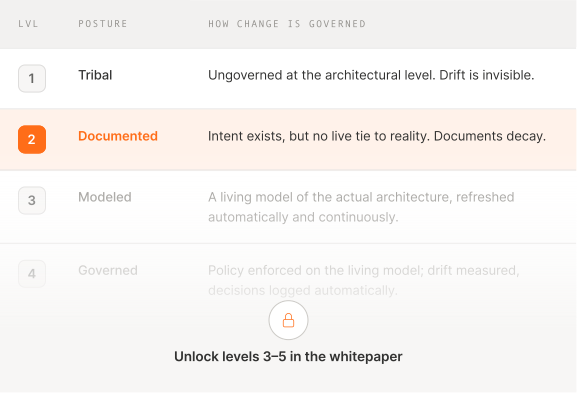

Catio reframes architecture as a living system that can be codified, introspected, and intelligently evolved over time.
on naming Catio "Coolest Tech," Transform 2025
From the field
CTOs who stopped reconstructing their architecture from memory.

"I'm excited about the visibility Catio brings, and the gaps it fills with reasoning and design guidance."

Emil Ibrishimov
CTO, Gem
"Catio grounds our decisions in a neutral perspective from the system itself, with efficiency gains comparable to GitHub Copilot."

Harald Prokop
CTO, Just Appraised
"Essential as we build more environments and need to analyze them. We'd need several more hires to do it otherwise."

Rick Myers
CTO, Gem

Who wrote this
Catio, the Architecture IDE.
Catio is the control plane for architecture decisions, designs, and the systems they produce. It pairs with coding IDEs like Cursor, Claude Code, and Kiro so teams can architect, then ship. Architects set the guardrails, Catio turns decisions into system-aligned specs, and drift flows back for exception-based review.

AWS-first
"Coolest Tech," VentureBeat Transform 2025
Free · Instant download
Get The Architecture Control Plane.
The CTO's framework for governing the AI SDLC. Four surfaces, a five-level model, a five-question self-assessment. Free, no sales call.
🔒 No spam, ever
Instant download
12-page PDF

The Architecture IDE. Architect, then ship, with a living control plane your agents can actually share.
© 2026 Catio, Inc.
The Architecture Control Plane · A Catio Whitepaper