July 14, 2026
Business Architecture: Definition, Framework & Examples

Every organization has a business architecture, whether anyone has documented it or not. The question is whether that architecture lives in a shared model people actually use, or whether it's scattered across slide decks, tribal knowledge, and a wiki page nobody has opened since the last reorg.
Business architecture is the discipline that makes an organization's capabilities, value streams, and structure explicit, so that strategy decisions and execution stay connected rather than drifting apart. This guide covers what business architecture is, how it differs from enterprise and solution architecture, the frameworks practitioners use, and why the practice is changing now that systems evolve faster than most architecture models can be manually updated.
What Is Business Architecture? (Definition)
Business architecture is the discipline that represents an organization's capabilities, value streams, information, and organizational structure, and how these elements connect to strategy, policies, and stakeholders. The Object Management Group's Business Architecture Working Group describes it more simply as a blueprint that gives an organization "a common understanding of the organization" and is "used to align strategic objectives and tactical demands."
In practice, business architecture is what a bank uses to determine that "manage deposit accounts" is a permanent capability even as the technology and policy behind it change every few years, or what an insurer uses to trace a new regulatory requirement down to the value-stream steps and systems it touches. It's less a diagram and more a shared reference model that strategy, operations, and technology teams point to when a decision affects multiple teams.
Business Architecture in Plain English
Think of business architecture as the org chart's more useful cousin. An org chart tells you who reports to whom. Business architecture tells you what the organization actually does (its capabilities), how value moves through it end-to-end (its value streams), and how those pieces map to the people, processes, and systems that make them real. A capability like "underwrite a policy" or "onboard a customer" doesn't change much year to year, even when the org chart and the tech stack behind it change constantly. That stability is the point: business architecture gives you a layer that doesn't get rewritten every time the company reorganizes.
What Business Architecture Is Not
- It's not IT documentation. Business architecture describes the organization's operating model, not its technology stack, and it's not a technical diagram of servers or applications. TOGAF explicitly separates Business Architecture from Application, Data, and Technology Architecture as its own domain.
- It's not only for large enterprises. The discipline scales down. A 200-person insurance MGA mapping its three or four core capabilities gets real value from the exercise, even without a dedicated team.
- It's not a replacement for business process management (BPM). Business architecture defines what the organization does and why it matters strategically. BPM defines how a process executes step by step. The two disciplines complement each other; neither substitutes for the other.
Business Architecture vs. Enterprise Architecture vs. Solution Architecture
These three terms are used interchangeably in job postings and broader discussions, causing more confusion than they should. Business architecture, enterprise architecture (EA), and solution architecture answer different questions at different altitudes, and mixing them up is one of the most common ways an architecture practice loses credibility with executives.
One practitioner interview quote you may come across puts it really well: business architecture "examines the business organisation as a whole," while its sister discipline of business analysis "typically adopts a more project- or programme-specific approach," and enterprise architecture "overlaps with business architecture" but often has a broader IT/digital delivery remit in practice.
When stacked up beside each other, it’s a bit easier to see the difference:
Business architecture is one of the four domains TOGAF defines under enterprise architecture, alongside application, data, and technology architecture. That places it inside EA's scope in most formal frameworks, even though many organizations run a business architecture practice with its own governance before an enterprise architecture function exists. Solution architecture sits downstream of both: a solution architect takes a capability gap or value stream requirement surfaced by business architecture and designs the system that closes it. Catio's guide to how system architecture differs from business architecture goes deeper into that boundary, since the two overlap heavily in how teams use the terms day-to-day.
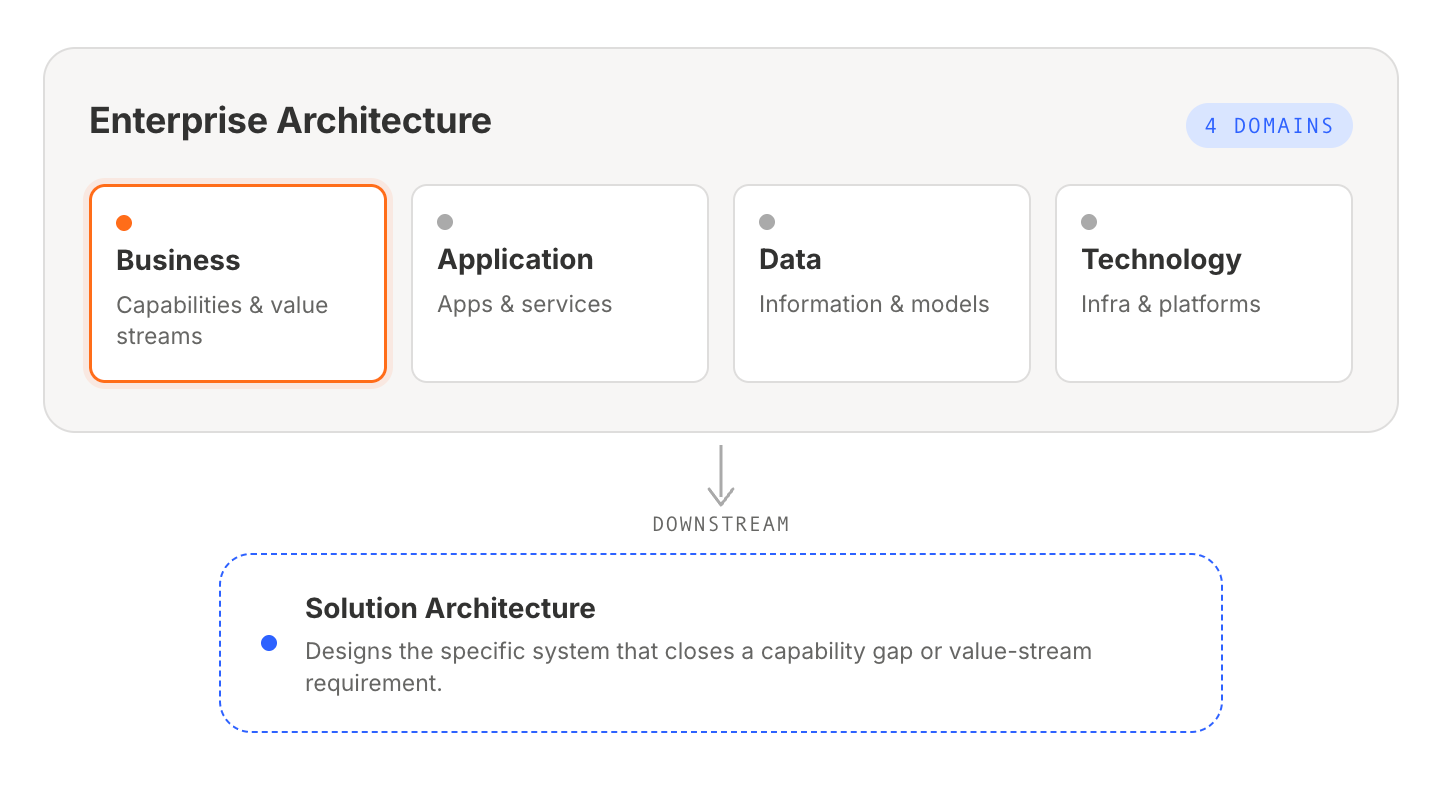
The practical difference shows up fastest when something goes wrong. If a merger falls apart because nobody could tell you which capabilities overlapped between the two companies, that's a business architecture gap. If a feature ships months late because two teams built incompatible services, that's a solution architecture gap. Most enterprise architecture tools try to cover all three altitudes in a single platform, with mixed results, because the questions a CFO asks about capability overlap rarely align with the questions a platform engineer asks about service boundaries.
The Core Components of Business Architecture
Strip away the framework jargon, and business architecture comes down to a small number of interlocking views. OMG's own reference model names five: business strategy, business capabilities, value streams, business knowledge (information), and organizational structure. Three of those show up in practice more than the others, so they're worth walking through individually.
Business Capabilities
A business capability describes what an organization does, not how it does it, and capabilities tend to stay stable even when the processes and systems behind them change constantly. "Process a claim," "manage supplier contracts," and "onboard a new employee" are all capabilities. None of them mention a specific tool or workflow, because a capability is defined at a level of abstraction that survives a reorg or a system migration intact. A capability map, typically organized into strategic, core, and enabling capabilities, is usually the first artifact a business architecture practice produces.
Value Streams
A value stream is the end-to-end set of incremental steps by which an organization delivers value to a specific stakeholder, internal or external. Where a capability answers "what can we do," a value stream answers "how does that turn into something a customer or employee actually experiences?" Mapping a value stream, say, "quote to bind" for an insurer or "order to cash" for a manufacturer, forces the organization to trace which capabilities get invoked at each step, often the first time anyone has documented the full path end to end.
Information Architecture & Organizational Structure
The remaining two views round out the picture. Information architecture (OMG calls this the Business Knowledge view) establishes shared semantics across the organization, so "customer" means the same thing to sales, finance, and support, rather than three slightly different definitions tracked in three systems. Organizational structure captures how roles, capabilities, and business units relate to one another, including how those units are decomposed into subunits and who manages them internally versus externally.
Together, strategy and goals, capabilities, value streams, information architecture, and organizational structure form what most practitioners think of as the core business architecture stack, with policies, standards, stakeholder relationships, initiatives, and outcome metrics woven through all five layers.

These views are interconnected rather than a strict one-way sequence: capabilities inform value streams just as often as value streams reveal gaps in the capability map, and organizational structure constrains both in practice.
Business Architecture Frameworks and Standards
A handful of frameworks dominate the way organizations structure their business architecture practices. None of them is mutually exclusive; most mature practices borrow from more than one.
- TOGAF treats business architecture as one of four architecture domains and requires it as a prerequisite step before application, data, or technology architecture work begins. The Open Group's current release is the TOGAF Standard, 10th Edition, building on the prior 9.2 release that specifically expanded the framework's Business Architecture and Content Metamodel guidance.
- BIZBOK Guide, published by the Business Architecture Guild, is the field's dedicated reference body of knowledge and the basis for the Guild's Certified Business Architect (CBA) credential.
- The Zachman Framework organizes enterprise concepts across six interrogatives (What, How, Where, Who, When, Why) and six perspectives; business architecture work often concentrates on the business-facing perspectives, or rows, rather than the more technical Engineer or Technician rows.
- OMG's modeling standards, including the Business Motivation Model (BMM) and Business Process Model and Notation (BPMN), help express motivation, rules, and process views that a business architecture practice may consume, using a notation that other disciplines can also read.
None of these frameworks tells you what your capabilities or value streams actually are. They give you a vocabulary for organizing that work once you've done it, which is why the framework choice matters less than most people assume when starting out.
Why Business Architecture Matters (Benefits)
The reasons why business architecture is important aren't that it produces nice diagrams. It's that decisions made without a shared capability and value-stream model tend to be expensive to unwind.
- Strategic alignment. When strategy and goals map explicitly to capabilities, you can trace a board-level objective down to the specific parts of the organization that need to change, instead of translating strategy into action informally and hoping every team interprets it the same way.
- Faster, better-grounded decision-making. A capability map turns "should we build or buy this?" into a question with a concrete answer by showing which capability the decision affects and who else depends on it.
- Mergers and acquisitions. Comparing two companies' capability maps is one of the fastest ways to find real overlap and real gaps during diligence, well before anyone reconciles org charts or system inventories.
- Digital transformation and risk management. Programs that touch multiple business units tend to fail quietly when nobody can see the full value stream a change will affect. A documented model surfaces those dependencies before they become production incidents or compliance gaps.
None of the top-ranking resources on this topic address a shift that's already reshaping how this work gets done: architecture practices are evolving fast for AI-native teams, where AI coding agents can restructure services, data flows, and integrations in the time it used to take a team to schedule a whiteboard session. A capability map or value stream diagram that assumes change happens at the pace of quarterly planning cycles starts drifting from reality within weeks, not years, in that kind of environment.
Common Business Architecture Challenges (and How to Solve Them)
Every organization that builds a business architecture practice eventually runs into the same set of problems.
Static documentation is the most common one. A capability map gets built during a strategy offsite, looks great in the resulting deck, and is out of date within two quarters because nobody owns keeping it up to date. Six months later, the "authoritative" model no longer reflects a reorg, two new systems, and a value stream that changed shape after a redesign.
Siloed models compound the problem. Different business units build their own capability maps in isolation, using different naming conventions and levels of granularity, so nobody can compare them or roll them up into an enterprise-wide view. This is the exact failure mode that makes M&A diligence painful: two capability maps that both look reasonable on their own turn out to be incompatible the moment someone tries to merge them.
The drift between architecture and reality is the underlying issue behind both. The model represents what someone believed to be true at the time it was drawn, and reality moves on without it. This is where the tooling question becomes unavoidable, and it's also the specific problem enterprise architecture tools exist to solve, with varying degrees of success depending on whether the tool is a static diagramming surface or something connected to what's actually running.
This is the place to talk about where Catio fits. Catio is an Architecture IDE built around a five-stage loop: Understand, Decide, Design, Execute, and Compound. Catio’s Understand stage connects the architecture model to the available runtime, repository, infrastructure, and data-flow context, keeping it closer to current system reality than a diagram someone drew once and hoped would stay accurate, though how current that picture stays depends on which sources are connected and how often they refresh. That doesn't replace the BIZBOK methodology or capability-mapping discipline a business architecture team already uses; it's the connective layer that keeps the model from going stale the moment the business changes again. Within Catio, Archie is a reasoning agent that can answer architecture questions conversationally, so stakeholders can ask about capability impact directly instead of hunting through a wiki page or a slide deck from two reorgs ago. GraphQA helps teams query the architecture graph to inspect relationships and dependencies, rather than relying solely on static diagrams. None of this replaces the judgment a trained business architect brings to defining what a capability actually is; it changes how long that definition stays true after someone writes it down.
How to Get Started with Business Architecture (Best Practices)
Starting a business architecture practice from zero is less about picking the perfect framework and more about sequencing the first few moves correctly.
Build a Capability Map First
Start with a top-level capability map before anything else. If the organization already has one, use it as a starting point rather than rebuilding from scratch; if not, a rough first version is usually enough to demonstrate value and get buy-in. Group capabilities into three tiers: strategic (board-level), core business (the activities that directly deliver the organization's value proposition), and enabling (HR, finance, IT, and other supporting functions). Keep the first version high-level: a capability map with 15-20 top-level capabilities is far more useful for early conversations than one with 200 granular entries nobody can hold in their head.
Secure Executive Sponsorship
Business architecture work touches every business unit, which means it can't succeed as a grassroots initiative alone. An early board-level or C-suite mandate increases stakeholder buy-in and gives the practice enough authority to secure time from subject-matter experts across departments who otherwise have no reason to prioritize a mapping exercise. Without that sponsorship, even a well-built capability map tends to sit unused.
Keep the Model Living, Not Static
This is the step most guides skip, and it's the one that determines whether the first two steps produce lasting value or a one-time deliverable. A capability map or value stream diagram is only as useful as its last update. Decide upfront who owns keeping the model current, what triggers a review (a reorg, a new system, a value stream redesign), and how the team will catch drift between the model and what's actually happening in the business. Practices that skip this step end up rebuilding their capability map from scratch every 18-24 months instead of maintaining one that compounds in value over time.
Business Architecture Roles and Careers
A business architect sits at the intersection of strategy and execution, translating board-level objectives into capability and value-stream terms that operations and technology teams can act on. The role differs from an enterprise architect's in scope: a business architect focuses on the organization as a whole and its non-technical operating model, while an enterprise architect's remit typically extends into application, data, and technology architecture decisions. The two roles overlap heavily at smaller organizations, where one person often wears both hats.
Most practitioners move into business architecture from adjacent roles, business analysis, enterprise architecture, or operations and strategy, since those roles already build familiarity with how a specific business operates. The Business Architecture Guild administers the Certified Business Architect (CBA) credential, built on its BIZBOK Guide, as one of the field's recognized certification paths, though it isn't required to practice as a business architect. For someone considering the career path, the fastest way to start is usually by asking to see the organization's existing capability map; if nobody can produce one, that gap is often the opening to build the first version.
Conclusion
Business architecture translates strategy into the capabilities and value streams that deliver it, and that translation only stays useful if the underlying model stays current. TOGAF, BIZBOK, Zachman, and OMG's standards each give practitioners a shared vocabulary, but none of them solve the harder problem: keeping a capability map or value stream diagram connected to an organization that keeps changing, especially now that AI-assisted development means the systems underneath that architecture can change faster than a quarterly review cycle can track.
That's the gap Catio is designed to address. Rather than replacing the discipline of business architecture, Catio functions as a continuous decision-making system for architecture, one designed to keep a model closer to current system reality than to what someone believed was true when they last updated a diagram. If your organization's business or enterprise architecture models tend to go stale between review cycles, explore how Catio's Architecture IDE approaches architecture as something that compounds over time instead of something you redraw from scratch every year.
FAQs
What does a business architect do? A business architect builds and maintains the models, primarily capability maps and value stream diagrams, that connect an organization's strategy to its operations and technology. Day-to-day, that means facilitating workshops with stakeholders across business units, documenting capabilities and value streams, and using those models to inform decisions such as where to invest, what to consolidate, and how a merger or reorganization will play out operationally.
What is the highest-paid type of architect? No single architecture role is universally the highest paid; compensation depends heavily on industry, region, and seniority. Enterprise and business architects at large financial services, insurance, and technology firms tend to command premium pay because these industries operate complex, high-stakes models. For current figures, check the Business Architecture Guild's career resources or a general compensation database for your specific industry and region rather than a number that will age quickly.
How do I become a business architect? Most people arrive at business architecture through business analysis, enterprise architecture, or operations and strategy roles rather than as a first job out of school. The practical starting points are building familiarity with how your organization actually operates, learning to build and use a capability map, and studying toward the Business Architecture Guild's Certified Business Architect (CBA) credential using the BIZBOK Guide.
How much do business architects make in the US? Compensation varies by region, industry, and experience, and any specific figure published here would quickly become outdated. The Business Architecture Guild's career resources and general labor-market compensation surveys are more reliable for current, region-specific numbers.
Share this Post