August 15, 2026
IT Architecture: Definition, Types & How It Works

Most IT architecture problems don't show up as outages. They show up as a routine change that takes weeks longer than it should, because nobody can say with confidence what depends on what. In practice, that's rarely a tooling gap. More often, no one owns a coherent, current picture of how the technology fits together and why it was built that way.
This guide covers what IT architecture actually means, the three layers that make it up, the components every architecture touches, and why the discipline is harder to practice well now than it was five years ago, written for IT managers, architects, and CTOs who need a working picture, not a repeat of the same textbook definition.
What Is IT Architecture?
IT architecture is the structured set of models, standards, and decisions that define how an organization's technology, from infrastructure to applications to data, fits together and supports its business goals. It spans three layers, enterprise, solution, and technology, and it functions less like a blueprint you draw once and more like a living map that has to stay accurate as systems change.
That "living map" framing matters more than it sounds like it should. A diagram of your information technology architecture drawn in January is already wrong by March if three teams shipped changes nobody documented. The diagram isn't the architecture; the actual, current relationship between your systems is, and the diagram is only useful if it keeps up.
IT Architecture vs. Enterprise Architecture
These terms get used interchangeably, but the two are scoped differently in how this guide breaks IT architecture down. Enterprise architecture is treated here as one layer inside IT architecture: the layer that connects business strategy and organizational structure to the technology that supports them. IT architecture is the broader umbrella, including enterprise architecture plus solution architecture (how a specific product gets built) and technology architecture (the infrastructure underneath everything).
An enterprise architect worrying about portfolio-level tech debt is doing different work than a solution architect scoping a single system, even though both sit inside the same IT architecture. For more on how these layers interact at the system level, see this guide to system architecture, a closely related but distinct discipline.
IT Architecture vs. Software Architecture
Software architecture is narrower still. It describes the internal structure of a single application or service: its modules, how they communicate, what patterns govern the codebase. IT architecture zooms out to the entire technology estate: every application, every integration, every piece of infrastructure, and how they collectively serve the business.
A useful test: "How should this service handle retries?" is software architecture. "Should we build this as a new service or extend an existing one, and what does that cost across the other twelve systems it touches?" is IT architecture. The second question requires visibility the first one doesn't.
The 3 Core Types of IT Architecture
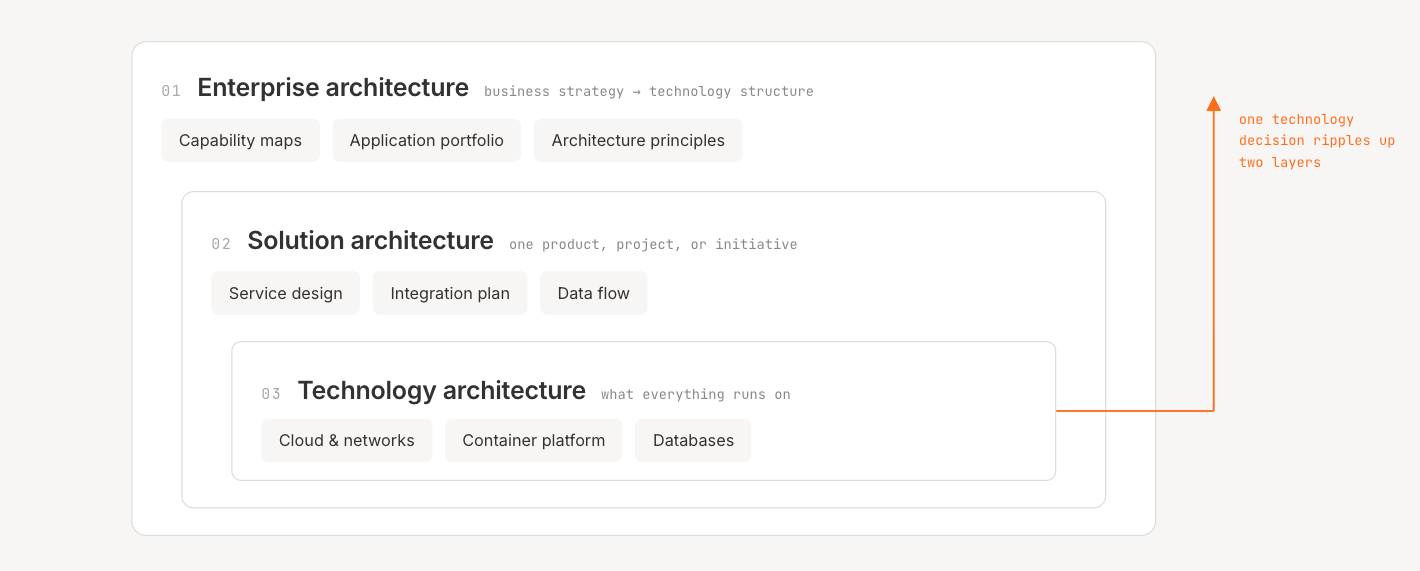
One practical way to break down information technology architecture is into three nested layers, from the broadest business-facing view down to the concrete technical implementation.
Enterprise Architecture (EA)
Enterprise architecture connects business strategy to technology structure: what capabilities does the business need, what applications and data support those capabilities, and where are the gaps or redundancies? EA typically produces artifacts like capability maps, application portfolios, business capability models, and architecture principles that govern decisions across the whole organization. This is also where most named frameworks, like TOGAF and the Zachman Framework, primarily operate, because their job is connecting business intent to technical execution across an entire organization rather than a single system. If you're evaluating platforms to manage this layer, this roundup of enterprise architecture tools that support this layer breaks down what to look for.
Solution Architecture (SA)
Solution architecture sits one level down, applying enterprise-level principles to a specific project, product, or initiative. When a team is building a new customer portal or migrating a payment system, the solution architect decides how that thing gets built: which services it needs, how it integrates with existing systems, what the data flow looks like. It's where enterprise strategy meets practical constraints (budget, timeline, tech debt, team skill sets). A solution architect who ignores the enterprise principles above ends up building something that works in isolation but fights the rest of the technology estate.
Technology Architecture
Technology architecture is the foundation: the infrastructure, platforms, networks, and tools everything else runs on. Cloud computing, container orchestration, databases, network topology. It's the layer most engineers interact with daily, even if they never call it "technology architecture."
The three layers aren't independent. A decision at the technology layer, say, moving from a monolithic database to a distributed one, ripples up through solution architecture (every service that talks to that database changes) and eventually enterprise architecture (the capability map and cost model shift too). Static documentation struggles here: a change made for infrastructure reasons has consequences two layers up that nobody updates in the enterprise architecture diagram.
Key Components of an IT Architecture
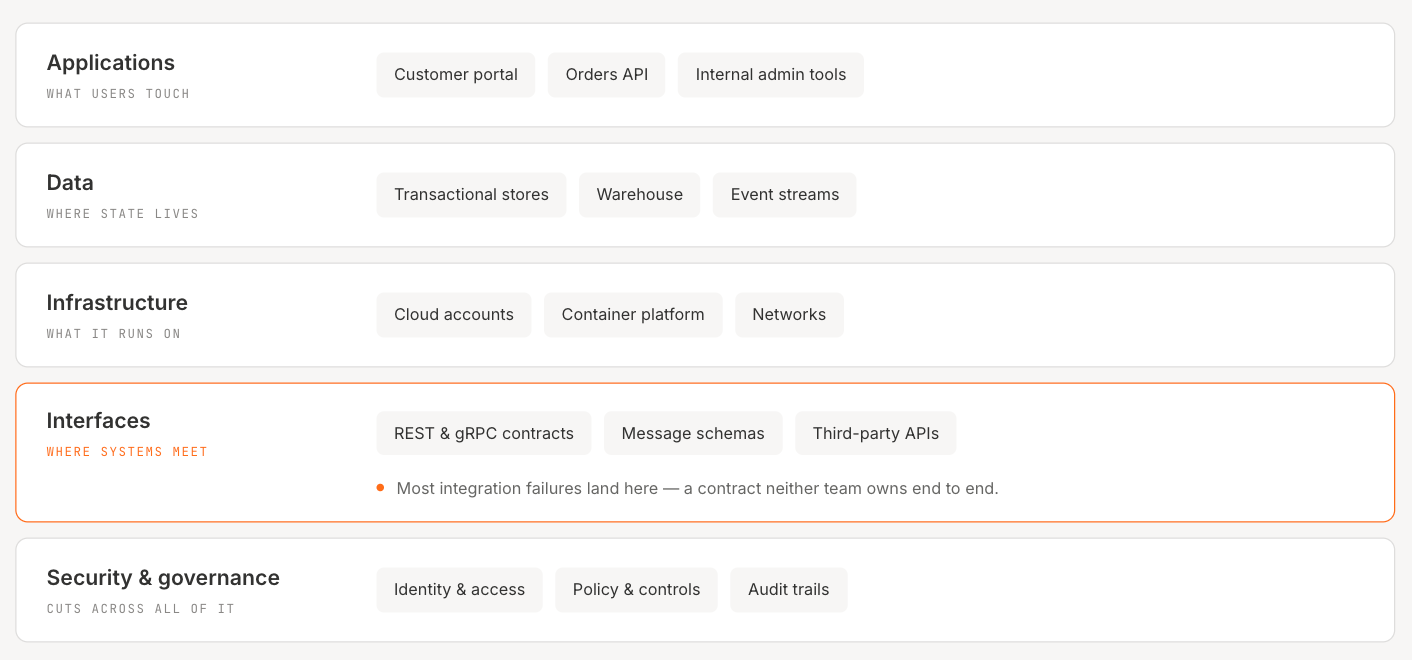
Regardless of layer, most IT architectures are built from the same recurring components. Understanding how they interact is more useful than memorizing the taxonomy above.
The interfaces row punches above its weight: system interfaces are where most integration failures happen, because two teams built to different assumptions about a contract neither one owns end-to-end.
Architects communicate these components using a shared visual language. One common standardized option is UML (Unified Modeling Language), which OMG defines as "a specification defining a graphical language for visualizing, specifying, constructing, and documenting the artifacts of distributed object systems." A well-constructed architecture diagram does more work than most teams give it credit for, translating a mental model into something a new engineer can actually use.
Why IT Architecture Matters
Bad IT architecture usually doesn't announce itself; it shows up as technical debt that compounds quietly: every new feature takes slightly longer than the last, every integration requires slightly more tribal knowledge from whoever last touched that part of the system, until a team spends more time working around the architecture than building on top of it.
Good IT architecture, by contrast, is what lets business strategy actually turn into shipped software. How fast a leadership decision becomes working systems depends on whether the underlying architecture supports it or fights it. An architecture built around interoperability and shared technology standards lets a new initiative reuse existing capabilities; one built around tightly coupled systems means every initiative starts from zero. A strategy that treats architecture as an afterthought ("we'll deal with the technical debt later") almost always pays for it twice: once in the original project, and again when the shortcuts taken to hit the deadline become the new baseline everyone builds around.
How IT Architecture Is Designed and Governed
Architecture doesn't design itself, and it definitely doesn't govern itself. Most organizations rely on named frameworks plus a dedicated role to keep architecture decisions consistent and defensible.
Common IT Architecture Frameworks
TOGAF, maintained by The Open Group, is one of the most widely adopted enterprise architecture frameworks. The Open Group describes it as "a proven Enterprise Architecture methodology and framework used by the world's leading organizations to improve business efficiency." Its Architecture Development Method (ADM) walks architects through a repeatable cycle from vision through implementation governance. The current major version is the TOGAF Standard, 10th Edition, though many organizations still reference the long-standing Version 9.2.
The Zachman Framework, as defined by Zachman International, takes a different approach: instead of a process to follow, it's a classification matrix organizing architecture artifacts across six perspectives (executive down to the functioning enterprise) crossed with six questions (what, how, where, who, when, why). It's less prescriptive than TOGAF, but useful for making sure nothing falls through the cracks.
Underneath both sits a formal standard for what an architecture description has to include: ISO/IEC/IEEE 42010:2022, which "specifies requirements for the structure and expression of an architecture description (AD) for various entities, including software, systems, enterprises, systems of systems, families of systems, products (goods or services), product lines, service lines, technologies and business domains." Most teams never read it directly, but its core concepts (stakeholders, concerns, viewpoints) shape how TOGAF and Zachman structure their artifacts.
The Role of the IT Architect
IT architects, sometimes titled enterprise, solution, or technology architect depending on the layer they work in, are accountable for the coherence of the architecture, not just its documentation. An architect who produces a beautiful diagram nobody follows hasn't done the job.
Day-to-day, the role involves evaluating trade-offs (build vs. buy, monolith vs. services), setting technology standards, and reviewing significant technical decisions before they ship. Many teams also capture those decisions as architecture decision records (ADRs), short documents that pair a decision with the reasoning behind it, so the why doesn't disappear once the diagram gets redrawn. It's a demanding, well-compensated field. As a related labor-market data point, the Bureau of Labor Statistics reports that computer network architects, a narrower occupational category than enterprise or solution architects, earned a median annual wage of "$130,390 in May 2024", with employment "projected to grow 12 percent from 2024 to 2034, much faster than the average for all occupations."
IT Architecture Challenges in Modern, AI-Native Environments
The frameworks above all share the same quiet assumption: that architecture documentation, once produced, stays roughly accurate. That assumption held up when systems changed on a quarterly release cycle; it doesn't hold up now.
In teams with mature AI-assisted development practices, the time between "someone has an idea" and "that idea is running in staging" is increasingly compressing from weeks to sometimes hours. A developer working with an AI coding assistant can stand up a new service, wire it into three existing systems, and get it running before the architecture diagram even gets opened. The diagram wasn't wrong when drawn, but it's wrong now, and nobody updates it, because updating a wiki page has never carried the same urgency as shipping the feature.
This is architecture drift: the gap between what your documentation says your systems look like and what they actually do. AI-assisted coding is only the newest accelerant. Cloud console changes made outside infrastructure as code, undocumented SaaS integrations, unmapped data flows, and emergency production fixes have been quietly causing the same drift for years. Drift used to accumulate slowly enough that an annual review could catch up. In AI-native environments, where the pace of change is set by how fast a model can generate working code rather than how fast a team can plan a sprint, drift compounds faster than most manual review cadences can track. Keeping architecture aligned stops being a documentation exercise and starts looking like a monitoring problem.
This is the gap a newer category of tooling is starting to address: rather than treating architecture as a diagram you draw and periodically revisit, some platforms now maintain a continuously updated architecture model grounded in the infrastructure, source code, and data flows they connect to, instead of what was last documented. Catio, for example, is built as an Architecture IDE structured around a multi-stage loop rather than a one-time artifact: an "Understand" stage builds that live model, a "Decide" stage surfaces trade-offs through a reasoning agent called Archie, and later stages, including "Compound," track how the system evolves and flag where implementation has drifted from the intended design. This kind of tooling doesn't replace the coding tools engineers already use to ship software, or a solution architect's judgment about how a service should be built. It changes whether the picture guiding that judgment is current or six months stale, and it's one example of how the discipline is adapting, not the only one.
As architecture patterns continue to evolve for AI-native systems, the organizations adapting fastest are the ones that stopped treating architecture documentation as a static deliverable.
Conclusion
IT architecture is the coherent structure- enterprise, solution, and technology layers working together- that aligns a company's technology with its business goals. Getting that structure right often separates organizations that can turn a business decision into shipped software in weeks from ones that need a quarter just to figure out what a change would break.
Getting it right once is the easier half of the problem; keeping it right as systems change, especially where AI-assisted development can outpace a team's ability to manually update documentation, is where most organizations are now struggling. If your architecture model can't keep up with how fast your systems actually change, it's worth looking at approaches built around a live, continuously updated picture rather than a periodically refreshed one. Book a demo with us to see how a continuously updated architecture model holds up against the pace of AI-native development.
IT Architecture FAQs
What does an IT architecture do?
It defines how an organization's technology, infrastructure, applications, and data work together to support business goals: setting standards, documenting how systems connect, and making sure new technology decisions fit the existing structure instead of fighting it.
Do IT architects need a degree?
Most hold a bachelor's degree in computer science, information systems, or a related field, and move into the role after years as a developer, systems administrator, or engineer. A degree isn't always a hard requirement, but the depth of experience the role demands typically takes years to build either way.
What is the role of an IT architect?
An IT architect evaluates technology trade-offs, sets architecture principles and standards, and reviews significant technical decisions to keep them coherent with the rest of the organization's systems. Depending on the layer they work in, that ranges from capability planning at the enterprise level to infrastructure decisions at the technology level.
What are the types of IT architecture?
The three core types are enterprise architecture (connecting business strategy to technology structure), solution architecture (designing a specific product or project), and technology architecture (the infrastructure underneath both). Most real-world architecture work touches all three layers to some degree.
Share this Post