August 11, 2026
Business Application Modernization: A Decision Framework

Most modernization programs stall for the same reason: nobody can agree on which application to fix first. Engineering wants to rewrite the monolith that's hardest to deploy. Finance wants to touch the system with the highest support cost. The business unit that actually depends on the application wasn't in the room at all.
Business application modernization is what happens when that decision gets made deliberately instead of by whoever argued loudest in the roadmap meeting. It's the practice of sequencing modernization work by business value and risk, not just by which codebase is oldest or ugliest. This guide covers the framework: how to score applications, map them to business capabilities, and avoid the pitfalls that turn a modernization program into a multi-year technical detour with no clear return.
What Is Business Application Modernization?
Business application modernization is the practice of deciding which legacy applications to update, replace, or re-architect based on the business value they deliver and the risk they carry, rather than by technical age or engineering preference alone. It sits one layer above traditional application modernization: the same rehosting, replatforming, and refactoring techniques still apply, but the question shifts from "how do we modernize this system" to "which systems do we modernize, in what order, and why."
That distinction matters more than it sounds. A ten-year-old claims-processing system with clean code and no compliance exposure might not need to move up the queue. A five-year-old customer-facing app built on a deprecated framework, but driving a large and growing share of new revenue, almost certainly does. Technical age is a poor proxy for business urgency, and treating it as the primary sorting criterion is how modernization budgets get spent on the wrong applications.
Our own guide to application modernization strategies covers the technical execution side in depth: the 5 Rs (rehost, replatform, refactor, rearchitect, replace) and how to choose between them once a system is queued up for work. This piece covers the layer before that: which applications get queued, and in what order.
Why Business Application Modernization Is a Growth Decision, Not Just an IT Project
Nearly every stalled modernization program shares the same origin: the program gets scoped, funded, and staffed as an IT initiative, with the business brought in only to sign off on the budget. That framing is backward. Modernization sequencing decides which parts of the business can move fast and which stay stuck, which makes it a growth decision first and a technical project second.
Legacy-bound systems tend to lock organizations into release cycles measured in months. Deployment frequency is one of the most consistent differentiators between high- and low-performing engineering organizations: DORA's 2022 State of DevOps Report found high performers deploying on demand, multiple times per day, while low performers deploy between once a month and once every six months, an estimated 417x gap in deployment frequency between the two groups. When a competitor ships weekly and your team ships quarterly because the underlying system can't support faster releases, that's a market-share problem with a technical root cause, not just an engineering inconvenience.
This isn't a hypothetical failure mode: Gartner has found that 41% of enterprise-architecture roadmaps don't provide consumable, actionable guidance, weakening the strategy execution and investment outcomes they're supposed to drive. A roadmap nobody can act on is functionally no roadmap at all.
Ownership has to be shared, not handed off. A business unit leader knows which capability is losing deals to a faster competitor; an architect knows which system is the actual bottleneck. Neither has the full picture alone, and a modernization plan built by only one side tends to optimize for the wrong thing: engineering elegance with no revenue case, or a business wish list with no accounting for what's technically feasible.
The Business Case for Modernization: Cost, Risk, and ROI
Technical debt doesn't stay technical for long. It shows up on the P&L as slower feature delivery, rising maintenance spend, and can eventually produce an incident that costs more than the modernization project would have. McKinsey's research on enterprise technology puts a number on this: CIOs surveyed reported that 10 to 20 percent of the technology budget earmarked for new products gets diverted to resolving technical debt instead. They also estimated that debt amounts to 20 to 40 percent of the value of their entire technology estate before depreciation.
That's the framing a CFO or business sponsor needs: not "this code is old," but "this system is quietly taxing every future project that touches it." A useful way to break down the business case:
- Total cost of ownership. Licensing, specialized staffing, workaround tooling, and the opportunity cost of features that can't ship all belong in the same conversation as the modernization budget.
- Compounding risk. Security patches slow on unsupported frameworks, and compliance gets harder to prove on systems nobody fully understands anymore. Risk here is a growing probability multiplied by an increasing cost, not a hypothetical.
- Delayed opportunity. Every quarter a high-value application stays on legacy infrastructure is a quarter competitors with modern stacks can out-ship you.
None of these translate into a single tidy ROI number, and that's fine. The goal is a shared vocabulary that lets a business stakeholder and an architect argue about the same trade-offs instead of talking past each other.
How to Prioritize Applications for Business-Driven Modernization
Most modernization guidance stops at "assess your portfolio" without saying what to actually score it against. A useful prioritization framework needs two axes: how much business value an application delivers, and how much risk it's currently carrying.
Score Applications by Business Value and Technical Health
Plot every application against two dimensions instead of one. Business value captures revenue impact, customer-facing exposure, and regulatory importance. Technical health captures maintenance cost, security posture, and how much team expertise still exists to support the system safely.
The top-left quadrant, high business value and low technical health, is where modernization budget should typically go first, though some of these systems may need containment, replacement, or risk mitigation before modernization depending on cost, ownership, vendor constraints, or regulatory timing. It's also, not coincidentally, the quadrant most portfolios avoid touching, because it's usually the system everyone is afraid to break. That's exactly why it needs a business-value/risk framework instead of a "whoever complains loudest" process.
Scoring criteria worth defining explicitly before you start plotting anything:
- Revenue impact (direct or attributable)
- Customer-facing exposure and usage volume
- Regulatory or compliance importance
- Maintenance cost trend (rising, flat, falling)
- Security posture and patch currency
- Remaining team expertise on the underlying stack
Even Presidio, which frames modernization as a business-driven lifecycle, describes a process (assess, then optimize, then evolve) rather than a way to rank specific applications against each other. That's the gap this framework fills: a way to actually decide which application moves first, not just agreement that "business value should matter."
Our guide to application modernization assessment walks through the technical side of an assessment in more depth, inventorying dependencies, code quality, and infrastructure constraints, once you know which applications belong in the queue.
Map Applications to Business Capabilities
Scoring individual applications is only half the picture. The other half is understanding which business capability each application supports, since applications rarely map cleanly to a single team or budget line. A "policy administration" capability might be split across three legacy systems. No single one of those systems would get prioritized in isolation, but together they determine how fast the business can launch a new product line.
Business capability mapping, a concept formalized in enterprise architecture frameworks like TOGAF, defines a business capability as a particular ability a business may possess or exchange to achieve a specific purpose, independent of how it's currently implemented in software. Mapping applications to capabilities instead of scoring them in isolation surfaces dependencies a technical inventory misses: two "low priority" applications might jointly support a "high priority" capability, changing the sequencing entirely.
A Framework for Aligning Modernization Decisions with Business Capabilities
Consider a mid-market company acquiring a smaller competitor to enter a new regional market. The acquired company brings a policy administration system, a claims workflow, and a handful of internal tools. None of these systems were on anyone's modernization roadmap last quarter, because none of them existed in this company's portfolio last quarter.
A purely technical modernization queue would rank these new systems by code age and leave them behind older, more familiar internal tools. A business-capability-aligned framework asks a different question first: what capability does the acquisition unlock, and which of the newly acquired applications sit directly in the path of that capability going live?
If the acquisition's entire strategic value is entering a new region within two quarters, the policy administration system supporting that region jumps to the top of the modernization queue, regardless of how old its codebase is, because it's now the single highest-leverage application in the portfolio. Everything else, including systems that scored higher on a pure technical-debt basis last quarter, waits.
A roadmap that is only revisited annually often struggles to handle this scenario. Business events like acquisitions, new go-to-market motions, and regulatory shifts change which capabilities matter most, and the modernization sequence has to move with those shifting priorities. A framework revisited only once a year during budget planning tends to run a quarter or two behind the decisions that actually matter.
Common Pitfalls When Modernization Ignores Business Priorities
Most stalled programs have plenty of technical skill on staff. What they lack is a process that optimizes for business impact instead of engineering preference.
Optimizing for elegance over impact. Given a free hand, engineering teams often choose the technically interesting problem over the highest-impact one: rewriting a monolith into microservices is a more satisfying project than patching a policy engine that quietly generates a substantial share of revenue, but only one of those moves the business forward this quarter.
Treating every legacy system as equally urgent. Not every old application is a liability; some are stable, low-traffic, and fine to leave alone. Sequencing by age instead of business value burns budget on systems nobody is waiting on, while the systems actually constraining growth sit untouched.
Skipping the capability-mapping step. Scoring applications individually, without mapping them to the capabilities they jointly support, misses compounding dependencies: two systems that are jointly critical can each get ranked as low-priority on their own.
No process for re-prioritizing mid-cycle. A framework that runs once a year often can't respond to an acquisition, a new competitor, or a regulatory deadline in month three. Roadmaps that treat scoring as a one-time exercise instead of an ongoing discipline can drift out of date within a single budget cycle.
How Catio Turns Business Priorities into Modernization Decisions
Everything above describes a framework you can run manually with a spreadsheet, a scoring rubric, and a recurring meeting. Catio's Recommendations module runs that same framework continuously, grounded in your actual architecture instead of a static inventory someone updated six months ago. The architecture model syncs with your connected infrastructure, code repositories, and service data, so business-value and technical-health scoring reflects current reality once those systems are linked in. Recommendations surface specific modernization opportunities with the gap between current and target state made explicit, with every option priced and its trade-offs, risks, and ROI made explicit, directly matching the score-and-prioritize framework above.
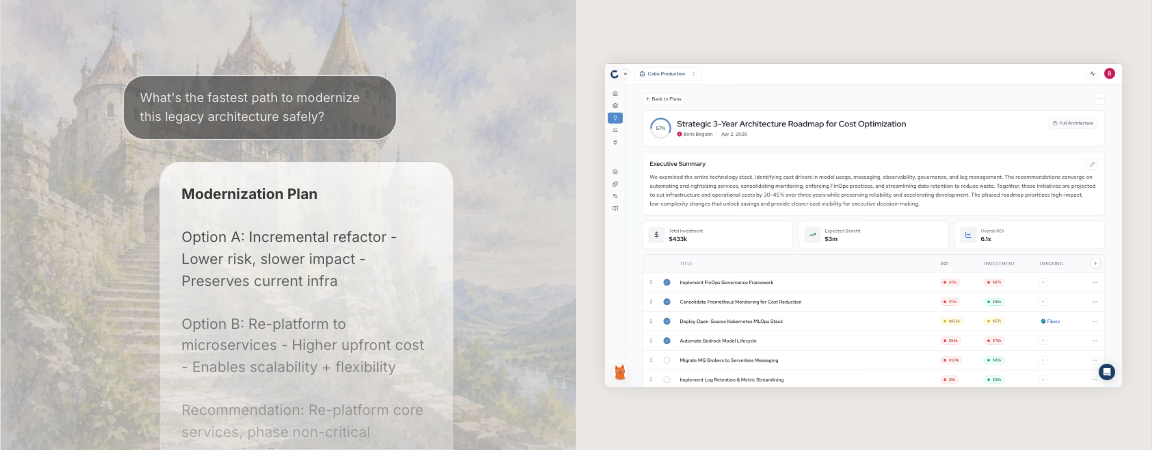
The Modernization Plan experience inside Recommendations lays out the decision the way a business stakeholder needs to see it: real options compared against your architecture, constraints, and goals, not a single take-it-or-leave-it suggestion. An incremental refactor might trade lower risk for slower impact; a re-platform to microservices might trade higher upfront cost for more scalability and flexibility. We attach a priced, ROI-based recommendation to that comparison instead of leaving it as an open menu.
For the plain-English version of that same question, Archie, Catio's conversational reasoning agent, lets a stakeholder ask something like "given our architecture, dependencies, and business constraints, should we modernize this application first?" Archie answers using the live architecture model, not a static spreadsheet someone forgot to update, drawing on whatever architecture inventory, requirements, and recommendations have been ingested into that model, so the answer accounts for dependencies a manual review would likely miss. As our own work on connecting architecture data to business strategy puts it, prioritization only stays useful if it's re-evaluated against what's actually true today. That continuous re-evaluation is the core idea behind our Architecture IDE: decisions grounded in the live system instead of a slide deck that's stale by the time anyone acts on it.
Worth being direct about a limitation here: we don't execute the modernization work ourselves. We don't migrate code, rewrite services, or replace infrastructure. We're the decision layer that determines which applications move first and why, before any migration project or coding tool gets involved. Teams still need their own execution capacity to carry out the plan once it's decided.
Conclusion
The hardest part of application modernization usually isn't the migration scripts or the framework upgrade; it's deciding which application to touch first, in a portfolio where every team has a reasonable-sounding case for why their system should be next. A business-value-and-risk framework, applied consistently and mapped to the capabilities that drive growth, turns that argument into a decision anyone in the room can defend.
Get the prioritization right, and the technical strategy tends to follow: once you know which application matters most, choosing between rehosting, refactoring, and rearchitecting is a narrower problem, though technical feasibility, dependency sequencing, data migration, and organizational capacity still determine whether the preferred strategy is executable. Explore our modernization-focused solutions to see how the Architecture IDE turns business priorities into a specific, sequenced modernization plan.
Frequently Asked Questions
What is business application modernization? The practice of deciding which applications to modernize, and in what order, based on business value and risk rather than technical age alone. It sits alongside traditional application modernization, which focuses on how to modernize a system once it's been selected.
How do you prioritize applications for modernization? Score each application on business value (revenue impact, customer-facing exposure, regulatory importance) and technical health (maintenance cost, security posture, team expertise), then plot them on a 2x2 matrix. Applications with high business value and low technical health move first. Map applications to the business capabilities they support to catch dependencies a single-application view misses.
What is the ROI of application modernization? ROI varies by application, but the business case typically combines reduced total cost of ownership, reduced compounding risk, and faster time to market on features currently blocked by legacy constraints. A useful business case quantifies all three rather than relying on a single "modernization saves money" claim.
What's the difference between application modernization and business application modernization? Application modernization describes the technical execution: rehosting, replatforming, refactoring, or replacing a system. Business application modernization describes the decision layer above that: which applications get modernized first, based on business value and capability alignment, before any technical execution strategy is chosen.
Share this Post