September 9, 2026
Enterprise Architecture AI: What the Human Actually Decides

The version of enterprise architecture AI worth arguing about in 2026 is a copilot that reasons against a live model of the running system instead of a wiki. Ask it what depends on the payments service and it answers from the estate rather than from a diagram somebody drew in March. That answer reaches as far as the estate is connected, and no further.
Nearly everything written about this converges on the same safeguard, which is that humans stay in the loop. That is now the consensus position, and it has stopped being useful, because it is asserted rather than specified. What almost nobody says is which decisions are the human’s by design, at which point in the work, on what artifact. This piece answers that, and the answer is more interesting than a person checking the output.
What Enterprise Architecture AI Means Right Now
In this article, enterprise architecture AI refers to software that reasons over a live model of an organization’s systems and their relationships, then proposes and evaluates architectural change against it. What separates it from earlier automation is that the reasoning runs against current state rather than documentation, and the output is a design proposal rather than a report.
What the Copilot Is Genuinely Good At
Begin with what is not in dispute, since the argument depends on this half being honest.
Four capabilities matter here. Retrieving structure, meaning what talks to what, transitively, bounded by what the tool can actually see. Surfacing divergence between what was intended and what got deployed. Generating options quickly, including the ones a tired architect would not reach for on a Thursday afternoon. And carrying context across time, so a question asked today is answered against decisions recorded earlier by people who may no longer be on the team.
That last one is underrated. We have argued before that coding agents now change systems faster than the architecture around them gets updated, and a durable record of settled decisions is what stops that gap from widening.
“Humans in the Loop” Has Become an Answer That Answers Nothing
Read what has been published on enterprise architecture AI this year, and the human-oversight point is everywhere, sometimes as a stated principle and sometimes as a closing reassurance. The phrasing varies. The opinions all converge towards the notion that a person should be able to monitor, intervene, override, and approve.
We argued a version of this ourselves in 2024, asking whether an AI agent would replace the people who make these calls: a model may propose optimal solutions in a vacuum, but it will not grasp your company’s history, culture, political landscape, or the subtle trade-offs that define a great leader’s decisions. That was right, and two years on, it is table stakes.
The consensus is correct and incomplete. It describes a safeguard where a mechanism is needed. An override tells you what happens in the exception case and leaves the normal one undefined. Applied literally, it produces a job where an architect reviews everything an agent generates, at a volume that makes the job worse.
The useful question is narrower. If judgment is load-bearing, where does it bear load?
A Working Model: Archie Reasons, You Decide
Here is the version we build, so the argument can be judged against a real one.
We built Archie as the conversational entry point to our architecture model. You start the way you would start at a whiteboard with a colleague: ask a real architecture question, and Archie reasons against your live system model and the memory of decisions you have already made. We introduced it as a copilot. It is not an oracle, and that distinction is the whole subject of this piece.
Within a selected workspace, Archie retrieves the services and relationships present in the live model, and coverage is bounded by the integrations feeding that workspace. Completeness in Stacks, the model underneath, is bounded the same way. A system we receive no data from is one Archie cannot reason about, which is a reliable way to get a confident blind spot.
Underneath, the reasoning runs as a set of specialized agents rather than one model, and those agents reason, ask questions, retrieve data, and make judgments. A system that makes architectural judgments will make them somehow, and the only open question is whose.
The Three Places Judgment Sits
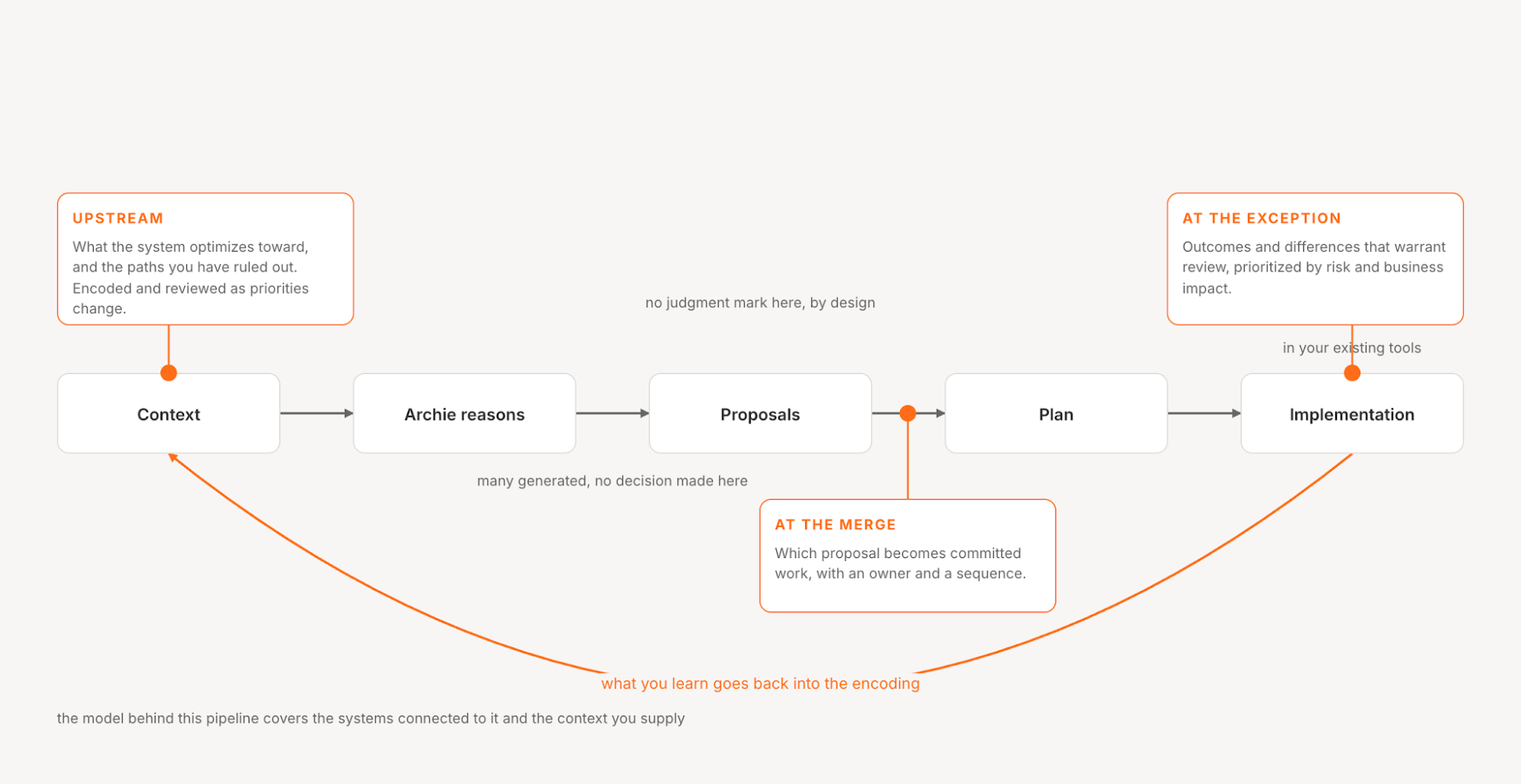
In the workflow above, three judgment points earn their place. This is the operating model we propose, not an official taxonomy, and a team working differently will draw the lines somewhere else. It does give the familiar list of architect decisions somewhere concrete to live. Conflicting trade-offs and the organizational incentives around them land upstream. Accountability lands at the merge. The calls with no precedent land at the exception.
Upstream, in What the System Optimizes Toward
This is the one the oversight framing skips, and it is the most important.
Given objectives and constraints, AI can propose ways to achieve them. Those proposals still need to reflect your organization’s decisions. There are many defensible paths to any architectural objective, and a model left to its own reasoning will pick one of them, not necessarily yours. That is why we treat encoding as a craft rather than a settings page.
A model can propose technically plausible architecture that still conflicts with your organization’s choices. Yours reflects settled arguments that exist nowhere except in the heads of the people who settled them: the patterns you approved, the trade-offs you will not relitigate, the paths you ruled out.
Encoding is what we call writing those down, so the AI does not just achieve the objective function; it achieves it the way your organization would. None of that is derivable from objectives and constraints alone, and it lives in the judgment of your architects.
Context splits the input into three parts. The objective is what you are trying to achieve and what you will not trade off. The constraints are the system as it actually runs, and you don’t supply that part: you don’t upload it, because it flows in live from your integrations and from Stacks. The steering is the encoding: standards, approved patterns, settled trade-offs, and the paths your organization has ruled out.
So two of the three inputs are human judgment, and neither is a review step. They are authorship, done once and maintained, before any output exists.
At the Merge Point
The second place is the one people picture when they say human-in-the-loop.
Our model for this borrows a shape engineers already know. A Blueprint, the artifact that comes out of the reasoning, is a pull request for your architecture. It names a base state, proposes a diff, argues for it, and gives reviewers a structured way to push back before anything merges.
The decision point is the merge, which here means adding the blueprint to a Plan. That is the point where a proposal becomes committed work with an owner and a sequence.
That distinction depends on a volume asymmetry that is easy to miss. A system can generate a great many proposals and has decided nothing by generating them. Very few reach a merge, because a merge means somebody committed to a sequence of work with an owner attached. The question is never whether AI can produce a good design. It is who is answerable when the design turns out to be wrong in eleven months, and the merge is where that name gets attached.
At the Exception
The third place is where a badly designed model would break. If human judgment meant reviewing every generated output, the architect’s throughput would become the system’s throughput, the bottleneck the tooling was supposed to remove. That is not how we set the loop up. Architects and leads set strategy and guardrails; we generate system-grounded designs, developers ship them in their own IDEs, and architects govern by exception rather than reviewing everything.
Review implementation outcomes and prioritize differences by significance, not just by when a change shipped. Where a spec missed, the architect asks why. A difference does not have to reach production to be worth that conversation.
Read alongside the first two, that is the trade the model rests on. Judgment sits in three places, and none is per-output review. It applies to every design through the encoding, to the small set of proposals that become committed work, and to the implementations that diverged enough to matter. The architect stops being the bottleneck through which every design must pass, and becomes the author of the control plane through which every design is generated.
What Goes Wrong When Teams Skip the Human Step
Skipping the upstream half does not leave the system neutral. An empty Context is not a neutral starting point; it is a workspace where every output gets optimized toward something you never chose.
The second failure arrives later and is harder to see. Encoded judgment nobody has revisited in a year does not sit there harmlessly, because it is enforced on every output that follows. Stale encoding is worse than missing encoding, and the fix is ownership rather than cleverness.
The third is coverage, ours to state rather than yours to discover. Our analysis is bounded by the connected sources and context you provide; infrastructure integrations are read-only, so a question about an unconnected system gets an answer from an incomplete picture. We work with architecture teams beyond AWS-only estates; the available integrations and evidence coverage need to be confirmed for your environment. We are a decision and design layer, not an observability tool.
What This Asks of Architects
Two practical consequences follow, more specific than the role-evolution genre usually gets.
Encoded judgment needs a named owner. We call this the most important governance decision in adopting us: one person accountable for the encoding staying current. Our view is that this means a named individual, not a committee or a rotation.
The bar for what to write down is lower than teams expect. The test we give is usefully concrete: if an architect would say it in a design review, it belongs in the encoding. Most organizations have years of that material written down nowhere, because no system could act on it.
Who Draws the Boundary
One point worth taking from outside the architecture world entirely. The Model Context Protocol specification standardizes how AI applications connect to external tools and data. Among its key principles: “Users must retain control over what data is shared and what actions are taken.”
The specification also makes implementers responsible for putting those principles into practice; the protocol itself does not enforce them.
Its scope is not ours, since that line is drawn around data access rather than design authority, and the structural point carries anyway. The technology doesn’t enforce the boundary between what a system does alone and what a person decides. Somebody makes that design decision, or fails to, and then lives with it. Nothing about having an architecture copilot determines where the line falls in your organization, ours included. You draw it.
Conclusion
A connected model reduces retrieval work, while human judgment remains necessary. It moved upstream into what you tell the system to optimize toward, to the merge where a proposal becomes committed work, and to the exceptions where an implementation and its spec parted company. What it did not do is settle onto every artifact, which is what the human-in-the-loop framing quietly assumes.
If you want to work that line out against your own system, our platform is one place to do it, and a walkthrough is the short version. The more useful exercise costs nothing: write down the three architecture arguments your team has already settled and does not intend to have again. If that is hard, the readiness problem is not the AI’s.
Frequently Asked Questions
Will AI replace enterprise architects?
Not based on the evidence of how the tooling is actually built. What it removes is the retrieval and reconstruction work, the least skilled part of the job. What it makes valuable is stating, precisely enough for a system to act on it, what your organization has already decided.
What is the role of AI in enterprise architecture?
Reasoning against a current model of the system and producing options and specifications from it. What it should optimize toward is not something it can supply for itself.
What should stay a human decision?
Three things, in the model above. What the system is optimizing toward and what it must not trade away. Which proposal gets committed to a plan with an owner. What to do about the cases that did not fit the guardrails. In our workflow, everything between those is the copilot’s, and another organization will draw that line elsewhere.
Does this mean approving every AI-generated design?
No, and a practice built that way will fail. Reviewing every output makes the architect the bottleneck again, at higher volume. Governing by exception is the workable version, and only if the judgment was encoded upstream first.
Share this Post