September 11, 2026
What Is an Enterprise Architecture Platform? (And How It Differs From a Tool)

In most buying conversations we sit in, “tool” and “platform” are used as synonyms, and most of the time that costs nobody anything. It starts costing something when you are deciding what to buy, because the two words describe products with different failure modes.
The useful question is not which features a product ships. It is where the product gets its picture of your estate, and what happens to that picture once you stop looking. This guide covers what a platform is, where the boundary is between a platform and a point tool, the capabilities that matter, and how to tell whether you need one. We wrote it for architects and engineering leaders weighing whether to buy, build, or leave the question alone.
What Is an Enterprise Architecture Platform?
We use the term to mean a system that can automatically refresh its model of an organization’s applications, data, and infrastructure from connected sources, then use that model to make decisions. The words aren’t applied consistently, and in the evaluations we get pulled into, the platform label sits happily on products that combine a repository, modeling, imports, and integrations without deriving anything. So treat what follows as our buying lens rather than a category definition: the property worth sorting on, not a claim about how the words are used elsewhere.
That lens weights where the model comes from rather than its features. Modeling, diagramming, portfolio views, and impact analysis all appear on both sides of the line. What separates them is whether the picture refreshes itself.
One caveat: automated refresh reaches furthest at the applications, data, and infrastructure layers, because that is where machine-readable ground truth exists. The business capability layer still depends on people agreeing on what the business can do, and no integration settles that for you.
Platform vs. Tool: Why the Distinction Actually Matters
We draw the line in one place, not where a feature matrix draws it: does the model refresh itself from connected systems, or does it wait for a person to update it? Every other difference is downstream of that answer.
Automated ingestion is not one capability sitting alongside modeling and reporting. It is the condition the others depend on, because every downstream answer inherits the currency of the model it came from.
A point tool produces an artifact: a diagram, a repository entry, a portfolio spreadsheet. The artifact is accurate on the day it is made, and from then on depends on somebody remembering to update it. A platform produces a model derived from the systems themselves, refreshed on the product’s ingestion cadence rather than on anyone’s memory.
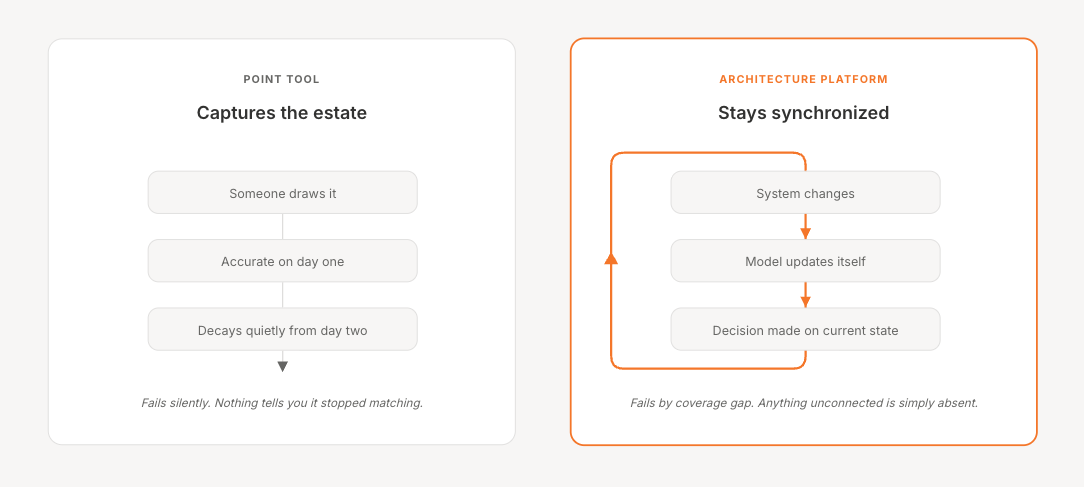
That is not a quality judgment. Point tools are fine, and often the right answer. But the distinction predicts what goes wrong. Point tools decay, because nothing tells you the picture stopped matching. Platforms develop coverage gaps, because anything outside what you have connected is simply absent from the model. Both failures are quiet, so either choice needs someone monitoring coverage and freshness rather than trusting the artifact on sight.
If you are at the stage of comparing named vendors rather than deciding what category you need, our guide to enterprise architecture tools does that comparison directly.
The Core Capabilities of a Modern EA Platform
Three capabilities distinguish a platform in practice. Each is a consequence of the synchronization property rather than a separate feature.
A Live, Physical-First Inventory
The inventory is the foundation: where it comes from determines everything downstream. A platform derives it from cloud accounts, source control, and observability data rather than asking a person to enter it. We built our own inventory that way, deriving it from subscribed integrations rather than from anyone typing it in. The trade is worth naming: nobody has to catalog the estate, and we only see as far as the integrations you connect.
“Physical-first” matters here. A logical inventory tells you a payments service exists. A physical one tells you which region it runs in, what instance type it uses, what it is connected to, and what the configuration said as of the last ingestion. The second is what you need when the question is “what breaks if we move this,” the difference between a logical picture and physical truth.
Continuous Decision Support
Documentation answers questions somebody anticipated. Decision support answers the question you have now, against the estate as it currently stands.
The practical difference shows up in latency. If answering “which services write to this database” means commissioning an audit, the answer arrives after the decision has been made. If the model is queryable, the answer arrives during the conversation, and you can attach the reasoning for the next person who asks. We built Archie as the conversational form of this: you ask in ordinary language, and the answer comes from your workspace’s current architecture rather than from a document somebody wrote last year.
Governance and Drift Detection
Drift is the gap between what was implemented and what was intended. A refreshed model makes detecting it across a whole estate possible, since comparing against intent requires a current picture of both sides. Infrastructure tooling already covers part of this: HCP Terraform’s health assessments run drift detection against the resources in a workspace’s configuration, and continuous validation against rules you write. Neither maps cross-service dependencies outside that configuration. What that leaves uncovered is a service quietly acquiring a dependency it was never supposed to have.
This capability also changes what governance can be. A review board meeting every two weeks against a stale picture ratifies decisions, not governs them. Exception-based review, where the platform surfaces what diverged, and humans look only at that, keeps pace with delivery.
Platform, Point Tool, or Status Quo? How to Decide
A platform is not the default answer. Look for specific signals rather than assuming more tooling is better.
The last row carries the most weight. A team that has already watched a hand-maintained model decay has evidence; a team that has not should build one cheaply and find out how fast it rots.
The build column is not a trap, but it has one predictable failure. Inventory scripts get written by someone who cares, and they survive as long as that person’s attention does. If you cannot name who owns it in year two, you are choosing the status quo with extra steps.
The status quo deserves more credit than it usually gets, right up until a decision gets made against a picture nobody has checked. The tell is not that documentation is missing; it is that people have quietly stopped consulting it. When engineers answer current-state questions by reading the Terraform instead of opening the wiki, the wiki has already lost.
What to Look For in an Enterprise Architecture Platform
Skip the feature matrix. Four questions separate products that hold up from products that demo well.
Where does current-state data come from? If the answer is import, upload, or manual modeling, you are evaluating a point tool at a platform price. Ask to see the model built from a live environment, not a prepared dataset.
What happens when the model and reality disagree? A platform should tell you. If the answer is that you will notice eventually, drift detection is not a real capability.
Are decisions first-class objects? The rationale behind a choice is what you need later, when somebody asks why the payments service talks to the warehouse database. If that reasoning lives in a Slack thread, the platform is storing structure without memory.
What does it produce? A diagram is not something a team can build from. A specification carrying target state, gap analysis, and an implementation plan is, which is why we ship Blueprints rather than pictures.
Framework support is worth checking last. The Open Group describes ArchiMate as “an open and independent modeling language” for Enterprise Architecture, supported by different tool vendors and consulting firms. Standards-based export reduces lock-in without eliminating it: run a round trip before you sign and confirm the destination preserves the relationships and metadata you need. Framework checkboxes still tell you nothing about whether the model is current.
Where We Sit, and What We Do Not Cover
We are one worked example of the pattern above, and the useful part is the boundary, not the feature list. We do not replace your coding IDE. We define what gets executed at the system level, and everything below follows from that one choice.
That boundary decides what we can answer. Because the model is derived from connected infrastructure instead of cataloged by hand, we can answer the questions your infrastructure already knows. In a connected stack, a component carries its relationships to other resources and the configuration details we ingested for it, and you can open any of them from the infrastructure view.
That is also why we can compare implementation against intent and see where execution has diverged from intent, the estate-level version of the drift comparison described earlier.
The same boundary sets the limits, which we would rather state than have you find. We only see as far as the integrations you connect, so anything outside them is absent from the model, and freshness is bounded by our ingestion cadence rather than instantaneous. Today, we support AWS estates at companies past the early-stage startup phase, and both conditions apply. We are a decision and design layer rather than an observability tool: we tell you what your architecture is and what to do about it, not whether it is up right now.
Conclusion: Start With the System You Actually Have
The platform-versus-tool question is easier once you stop treating it as a feature comparison. A tool gives you a picture someone has to maintain. A platform gives you one the systems maintain for you, within the coverage you have connected. The difference only shows up months later, in whether the plan you built on it was scoped against the right estate.
So start from what you already have. Take a real decision you are facing, time how long it takes to answer the current-state question underneath it, and see how much you trust the answer. If it goes fine, you have saved yourself a purchase.
If it didn’t, the useful next step isn’t a feature demo. Bring us a real decision: put the question you could not answer to Archie against your own estate rather than against a prepared dataset.
Frequently Asked Questions
What is the best enterprise architecture tool?
There isn’t one, and any list that names a winner is telling you about its own methodology rather than your estate. The decision splits first on category: whether you need a documentation tool or a model that refreshes itself. Only then does vendor comparison make sense, and our tools guide you through it against named products.
Is TOGAF still relevant?
Yes, as a reference for what a mature practice eventually covers and as shared vocabulary between architects. It is less useful as a project plan for month one, and The Open Group’s guidance is to configure the standard for your practice rather than run it as shipped. Framework and platform are separate decisions; adopting one does not determine the other.
What are the four main types of enterprise architecture?
Business, data, application, and technology architecture. This split comes from TOGAF and isn’t universal: Zachman classifies along a different axis, and FEAF v2 uses six sub-architecture domains. Treat four as working shorthand.
What are the 5 components of enterprise architecture?
No canonical list exists, which is why answers vary. The common version is the four domains above plus a governance or principles layer keeping them consistent. If your organization has adopted a framework, use its breakdown.
Share this Post