May 24, 2026
How to Modernize Legacy Applications: A Step-by-Step Guide

Most legacy application modernization programs don't fail because the technology is wrong. They fail because teams modernize legacy applications in the wrong order, underestimate dependencies, and treat what's really a multi-year modernization project like a single phase. By the time leadership sees the spend, the original business case has shifted, and the team is still mapping a portfolio they thought they understood.
This is the execution playbook for teams moving from modernization intent to delivery. It assumes you already know what application modernization is and why it matters. What you need is a sequenced, defensible way to actually do it: a framework for selecting modernization strategies for each legacy application, a dependency-aware roadmap, and the discipline to ship in waves rather than one disastrous rewrite. We'll cover the 7 R's, the seven concrete steps, the AI-era shortcuts that are real, and the anti-patterns that quietly burn modernization efforts.
What Counts as a "Legacy Application" in 2026?
Legacy applications are systems that no longer fit your current architecture, compliance posture, talent pool, or business needs, regardless of age. A three-year-old Node.js service running on an unsupported framework version qualifies as legacy. A twenty-year-old COBOL system processing claims reliably and cheaply may not. The defining trait isn't age. It's a misfit between legacy systems and what the business now needs them to do.
In 2026, three new pressures push more applications into the legacy systems bucket. AI-driven development cycles expose application architecture that can't ship safely at AI speed. Cloud-cost discipline exposes legacy apps that were lifted and shifted but never optimized. And regulatory shifts around data residency, AI usage, and software supply chain push outdated technologies in authentication and observability below current minimums. A modern application that was fine in 2023 can become a legacy application in 2026 without changing a line of code.
The Real Cost of Not Modernizing
High maintenance costs are the most visible part. Engineering hours pour into keeping outdated systems alive: patching outdated technologies and unsupported runtimes, working around brittle integrations, paying premium rates for scarce skills. Gartner's research on infrastructure technical debt finds that around 40% of infrastructure systems already carry a significant technical debt burden, and organizations using structured methods for managing it report substantially fewer obsolete systems over time. The teams ignoring it pay multiples more in maintenance costs than peers who treat it as a portfolio problem.
The invisible costs are larger. Security vulnerabilities compound while end-of-life frameworks accumulate unpatched CVEs that appear in the NIST National Vulnerability Database but are never fixed by the vendor. Compliance gaps widen as auditors raise the bar on encryption, identity, and supply-chain provenance. Talent risk shows up in hiring funnels: engineers fluent in modern technologies aren't applying to maintain legacy systems, and the engineers who can are retiring.
Then there's opportunity cost, which finance teams rarely model. Every quarter, legacy applications stay in their current state is another quarter the team can't safely add new features, move data to modern platforms, or hit a customer commitment that depends on legacy systems flexing. The accumulating underlying technical debt doesn't just slow current work. It narrows the digital transformation moves the business can make next.
When to Modernize (Decision Triggers)
Legacy software modernization isn't always the right call. The honest answer is that most portfolios contain legacy applications that should be modernized, others that should be retired, and others that should be left alone. Trigger events are how you tell them apart.
Six triggers show up repeatedly across modernization efforts: runtime or framework end-of-life with no upgrade path, security and compliance findings that can't be remediated in place, talent loss when the last engineer who understands legacy systems leaves, infrastructure cost spikes after a cloud lift-and-shift, M&A activity forcing consolidation of existing systems, and an AI or analytics initiative that the current architecture physically blocks. Any single trigger may justify one legacy application modernization initiative. Two or more triggers hitting the same system at once is usually a signal that legacy systems are now actively constraining the business.
When evaluating triggers, run a three-bucket sort: stay, modernize, or replace. Stay covers legacy applications that are healthy and useful, for which the cost of modernization exceeds the benefit. Modernize covers legacy systems that deliver business value but whose current form blocks something specific. Replace covers cases where the business function is better served by a SaaS product or a clean rebuild than by incremental change. The point of the sort isn't to pick a strategy yet. It's to stop spending engineering hours on the many legacy systems where the strategy should be "do nothing" or "turn it off."
The 7 R's of Legacy Modernization
The 7 R's started as a cloud migration framework, but it has become the most widely used framework for classifying modernization strategies across a legacy application portfolio. AWS popularized it, and the official AWS Prescriptive Guidance defines the seven migration strategies used to categorize how a workload moves to modern systems.
Each R is a different commitment level, with different costs, risks, and timelines.
Retire. Decommission applications that no longer add value. The cheapest modernization is the one you don't do. Best for: shadow apps, duplicates, low-usage internal tools.
Retain. Leave the app where it is, for now. Document the decision and the trigger that would change it. Best for: working systems with high replacement cost and no urgent driver.
Rehost. Lift and shift to a new environment with no code change. Best for: data center exits, urgent deadlines, apps slated for further work later.
Relocate. Move at the infrastructure layer (typically VMware to a cloud VMware service) without touching the app. Best for: large VMware estates needing fast cloud transit.
Replatform. Make targeted infrastructure changes without redesigning the app: managed databases, container runtimes, managed queues. Best for: apps where the bottleneck is the platform, not the code.
Refactor. Restructure internals without changing external behavior. Decouple modules, fix data layers, introduce tests. Best for: strategic apps with poor structure that need to be ready for a future microservices or cloud-native move.
Repurchase (and Rebuild). Replace legacy applications entirely. Repurchase, AWS's seventh R, means adopting a SaaS product that covers the same business function as the legacy software. Rebuild is the broader framework cousin: writing a new modernized application from scratch on a modern stack with modern technologies, often treated as the deeper end of refactor/rearchitect work. Best for: apps where incremental change costs more than starting over, or where a SaaS now covers 90% of the original requirements.
The choice depends on three inputs: the business value of each legacy application, the technical health of legacy code, and the team's capacity over the next 12 to 18 months. The right modernization approach selection varies across legacy applications in the portfolio.
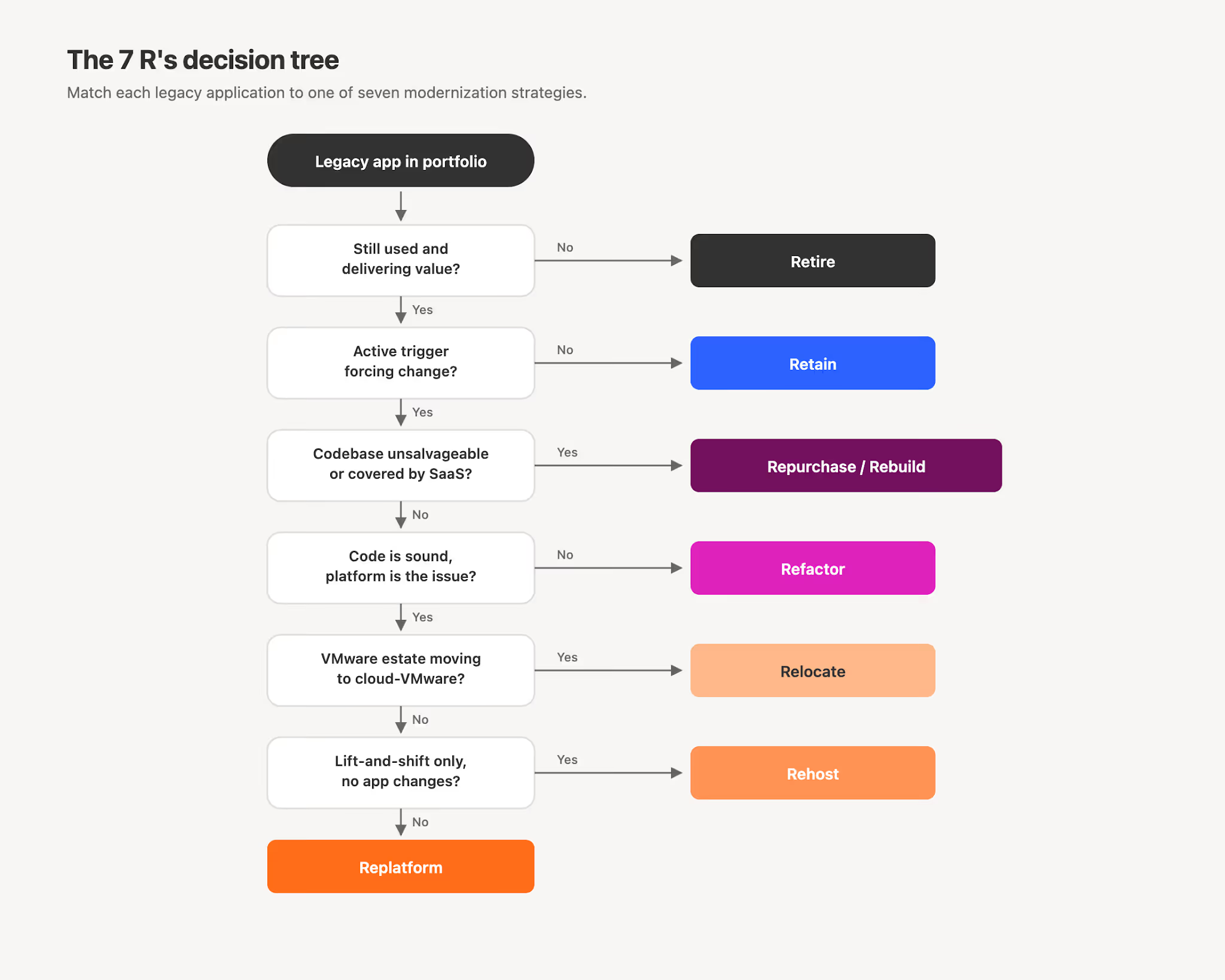
Figure 1. The 7 R's decision tree: a sequenced filter for matching each application to one of the seven modernization strategies.
How to Modernize Legacy Applications (Step-by-Step)
Legacy application modernization at the portfolio level is a seven-step workflow. Each step in the modernization process gates the next: skip one and the later steps inherit assumptions they can't validate.
Step 1: Discover and inventory
You can't modernize legacy systems you can't see. Most organizations start with an incomplete CMDB, stale architecture docs, and tribal knowledge in the heads of senior engineers. Before scoring any application, build a current-state inventory of legacy systems: every service, app, owner, team, runtime, dependency, and cost line. Pull from cloud accounts, continuous integration systems, observability tooling, and code repositories. Spreadsheets won't keep up.
Architecture observability platforms collapse this step from months to days. Catio's visibility and rationalization solution discovers services, dependencies, ownership, and cost signals across cloud environments, then helps teams classify which legacy applications are candidates for modernization. The trade-off is real: a stale inventory will produce a stale plan, no matter how good the scoring rubric is.
Step 2: Assess and prioritize
With the inventory in place, score legacy applications on two axes: business value and technical health. Business value covers revenue impact, customer-facing exposure, regulatory weight, and strategic dependencies. Technical health covers maintenance costs, security posture, scalability, observability, and team expertise. Apply weights aligned to business goals with executive sponsors and lock them before scoring begins.
A dedicated modernization assessment is the right artifact at this stage. The comprehensive assessment produces a prioritized backlog instead of a list, and it forces the conversation about what to retire (almost always more legacy applications than the business expects).
Step 3: Choose your R per app
For each legacy application that survives prioritization, pick from the 7 R's modernization strategies. The choice is rarely obvious. High-value legacy applications with sound application architecture may only need replatforming. High-value legacy applications with structural problems may need a refactor before any platform move. Low-value legacy applications with high maintenance costs are probably retired, not rehosted.
Document the strategy choice with explicit trade-offs: cost estimate, risk profile, expected ROI window, and the dependencies that could derail it. Decisions documented this way survive personnel changes. Decisions made in a meeting and never written down don't.
Step 4: Map dependencies
Legacy applications don't exist in isolation. The monolith you want to refactor is probably the source of truth for three other systems' customer data. The service you want to retire is probably read by an internal tool no one remembers building. Dependency mapping is where most legacy application modernization programs uncover the work they didn't budget for.
Manual dependency mapping (interviews, diagrams, sticky notes on a wall) is incomplete by definition. Owners know what they call. They don't always know what calls them. A live digital twin pulls dependencies from runtime telemetry, network flows, and configuration, then keeps the picture current as the architecture evolves. That's the operational definition of useful architecture diagrams in 2026: not a Lucidchart file, but a model that reflects what's actually running.
Step 5: Build the roadmap
Sequence the work into waves. Each wave should have explicit entry criteria, exit criteria, owners, and a measurable business outcome. Front-load early wins to build credibility and de-risk the modernization project. Save the hardest rearchitecting work for the middle of the modernization journey, after the team has shipped a few smaller modernizations and has the operational maturity to handle a bigger change.
The traditional timeline for roadmap alignment is weeks of architecture-review meetings. Catio compresses that: customers have moved from discovery to a 2-3 year modernization roadmap in a 2 to 3 hour working session, grounded in their live architecture, with ROI-backed recommendations per app. The output isn't a Gantt chart. It's a prioritized backlog that the engineering org can commit to.
Step 6: Execute in waves
Run the modernization process in disciplined waves. Each wave is a pilot, then a scale-out, then a retirement of legacy software. Use the strangler fig pattern for any in-place legacy software modernization: build the modernized application alongside the legacy code, route traffic gradually, and retire the old only when traffic is zero and tests pass. Blue-green deployments and feature flags give you the rollback options you'll need at least twice.
Resist the urge to start a second wave before the first finishes. Concurrent waves multiply blast radius across legacy systems and dilute the team's attention.
Step 7: Measure ROI
Define success metrics aligned with business goals before each wave begins. Deployment frequency, change-failure rate, lead time for changes (the DORA metrics), and mean time to recovery are the cleanest signals that application modernization is improving delivery and yielding improved performance, enhanced security, and cost savings. Cost metrics matter too: cost per transaction, infrastructure spend per service, and engineering hours per feature. Report the metrics to the same executive sponsors who approved the program. Application modernization that can't show measurable improvement after a wave isn't modernization. It's churn.
How AI Is Changing Legacy Modernization
AI is changing legacy application modernization in two ways: the mechanical work and the architectural reasoning. The mechanical layer is what people notice first. AI code translation tools convert COBOL to Java or .NET, generate refactored unit tests, and identify dead code that has been waiting to be retired for a decade. In its Predicts 2026: AI Potential and Risks Emerge in Software Engineering Technologies report, Gartner forecasts that by 2028, GenAI will reduce application modernization costs by 30% compared with 2025 levels, with much of the savings coming from automated code analysis and translation that previously consumed weeks of senior engineers' time.
The architectural layer is where the larger leverage sits. The high-cost decisions in legacy app modernization aren't the lines of code, they're the choices among modernization strategies: refactor or rearchitect, microservice or modular monolith, cloud-native or replatform-and-stay. Architecture intelligence platforms now treat these decisions as the unit of work. Catio's Archie answers questions like "what's the modernization risk on our payments stack?" or "what depends on the order service?" against a live digital twin, with sourced answers in seconds instead of analyst-weeks.
The realistic limit is worth naming. AI doesn't replace architectural judgment. It can compress parts of discovery and dependency analysis from weeks into hours when the underlying system data is available, and it surfaces options with cost, risk, and ROI signals attached. The humans still make the call. The change is that the call is made with a current picture of legacy systems, rather than a stale one.
Common Anti-patterns and Pitfalls
Five anti-patterns derail more legacy system modernization initiatives than any technology choice.
Big-bang rewrites. A complete rewrite of a critical system, on a fixed timeline, with no incremental delivery. These projects fail with a regularity that should embarrass the industry, and the strangler fig pattern exists precisely because the alternative has a public record of failure going back decades.
Skipping dependency mapping. Teams modernize one app, ship it, and discover three other legacy systems break in production. The fix is upstream: a live dependency map, not a one-time inventory.
Modernizing the wrong legacy applications first. Programs lose air when the first wave ships and the business doesn't notice. Pick early waves for visible business outcomes, not technical elegance.
Tools without architecture. A code translation tool can convert a Java 8 service to Java 21. It can't tell you whether legacy app modernization is the right call for that service. Tools execute. Architecture intelligence helps teams decide.
Cost surprises after cloud migration. Lift-and-shift to AWS often costs more than the on-premises baseline. The fix isn't to skip the move. It's to budget the replatform or refactor that the rehost was supposed to precede, and to monitor cloud spend per service from day one.
Ignoring data migration. Schemas embed business logic that no one documented. Splitting a database to support microservices surfaces dependencies that the application architecture hides. Budget data migration as a first-class workstream, not an afterthought.
Modernization Tools and Platforms
The tooling landscape for legacy application modernization can be divided into five broad categories.
Code translation tools convert existing code in legacy languages to modern ones (Java upgrades, .NET migrations, COBOL-to-Java translation). Refactoring platforms operate on syntax trees to restructure existing code at scale. Cloud migration platforms from AWS, Azure, and Google Cloud handle the mechanics of moving workloads to a cloud environment that exposes cloud native capabilities. Observability tools give you the runtime signals you'll need before, during, and after the move. And lastly, architecture intelligence platforms (Catio's category) give you the system-level view of which legacy applications to modernize, in what order, and with what blast radius.
These layers are complementary, not competitive. Code translation tools modernize one application at a time. Architecture intelligence tells you which legacy applications to point them at. For a deeper modernization software comparison across each category, the companion roundup covers vendors, strengths, and overlaps.
A Sample Modernization Roadmap (Worked Example)
Consider a mid-market enterprise with 80 legacy applications across cloud and on-premises infrastructure. After a comprehensive assessment of the portfolio, the team identifies three priority targets for legacy system modernization: an order management monolith, an internal claims-processing system on an aging Java stack, and a customer-facing API gateway that can't scale to peak load.
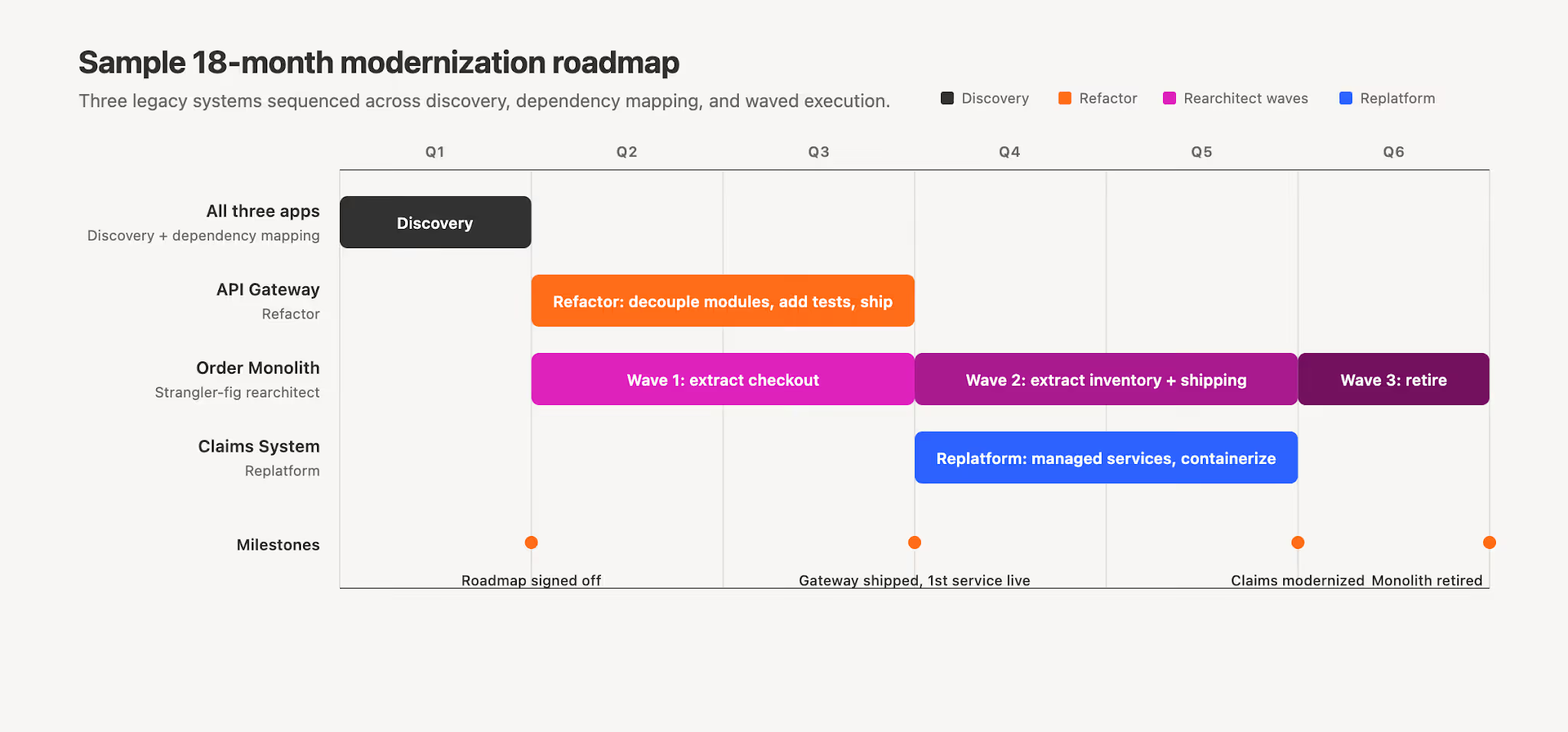
Figure 2. Sample 18-month roadmap: three legacy systems sequenced across discovery, dependency mapping, and waved execution.
Months 1-3 cover discovery, dependency mapping, and strategy selection: the API gateway is scoped for a refactor, the order monolith for a phased rearchitect using the strangler fig pattern, and the claims system for a replatform onto managed services. Months 4-9 deliver the API gateway refactor and the first extracted service (checkout) from the order monolith. Months 10-15 handle the claims replatform and the next wave of order-monolith extractions (inventory and shipping). Months 16-18: Retire the original monolith after the remaining traffic has moved off.
The total modernization project spans three legacy applications over 18 months, with a measurable business outcome delivered every quarter. That cadence, not the technology choice, is what makes the modernization journey work.
Conclusion
The teams that modernize legacy systems fastest in 2026 aren't the ones with the biggest budgets. They're the ones who see their architecture clearly before they commit a single engineering hour. Discovery, dependency mapping, and disciplined wave execution beat heroic rewrites every time.
That's where AI-driven architecture intelligence is reshaping digital transformation. Catio compresses discovery and roadmap planning by grounding decisions in a live model of architecture, dependencies, ownership, and cost. In customer workshops, teams have moved from discovery to a draft multi-year modernization plan in hours instead of weeks, with the system-level view engineering leaders need to decide which legacy applications to modernize, in what order, and with what blast radius. As Harald Prokop, CTO at Just Appraised, put it: Catio delivers "efficiency gains comparable to those of GitHub Copilot," but for the architecture decisions that come before the code.
See how Catio cuts modernization discovery from weeks to days. Book a demo of the Modernization solution to walk through a real plan grounded in your live architecture.
Frequently Asked Questions
What does "modernize legacy applications" mean? Modernizing legacy applications means updating their architecture, runtime, or platform so they meet current business needs, enhance security and compliance, and support operational requirements. The work can range from a lift-and-shift to a complete rebuild, depending on the application's business value and technical health.
How long does legacy modernization take? A single legacy application modernization typically runs 1 to 24 months, depending on the strategy. Rehosting of legacy apps can be completed in weeks; full rearchitectures often take 9 to 18 months. Portfolio-level modernization efforts covering dozens of legacy applications usually run on a 2- to 5-year horizon, executed in waves.
Which is the best modernization strategy: rehost or refactor? Neither is universally best. Rehost is right when speed matters more than optimization, typically before a data center exit or licensing deadline. Refactoring is right when legacy applications have long-term strategic value and their current code structure blocks further evolution. Many programs do both: rehost to meet a deadline, then refactor when the team has cloud operational maturity.
How much does it cost to modernize a legacy application? Costs vary by orders of magnitude. A simple rehost can run tens of thousands of dollars per legacy application. A full rearchitect of a complex system runs into the millions. The largest cost driver isn't the technology; it's the completeness of the upfront, thorough assessment. Programs that invest in accurate discovery and dependency mapping spend less overall, deliver improved performance sooner, and yield cost savings.
What's the difference between modernization and migration? Migration moves an application to a new environment with little or no change to the application itself (typically on-premises to a cloud environment). Modernization produces a modernized application with new architecture, dependencies, or operational model. Migration is often a step inside a broader legacy application modernization program, but moving an application to the cloud without modernizing it usually preserves the original problems on more expensive infrastructure.
Share this Post