May 20, 2026
Reducing Technical Debt: A 2026 Playbook for CTOs

Most software development organizations know they have too much technical debt. They have a backlog of "should fix" items, a Slack channel where senior engineers complain, and a slide in every quarterly review committing to "pay it down." Twelve months later, the backlog is longer, development cycles are slower, and bad code is everywhere.
The standard software development advice on managing technical debt hasn't changed in a decade: the Boy Scout Rule, fix-it Friday, and a 20% sprint allocation. It's also why your technical debt keeps growing, because it optimizes for code-level cleanup while the technical debt that matters compounds one level up. This is a playbook for software development leaders who know what tech debt is and want to know what to do about it.
Why Technical Debt Reduction Stalls in Most Organizations
Most efforts at managing technical debt stall because organizations treat debt as a backlog problem when it's actually a visibility problem. Teams can't prioritize what they can't see, fund what they can't quantify, or finish what no executive sponsors. The result is a year of "we'll get to it next sprint," while accumulated technical debt grows.
The cost isn't theoretical. McKinsey's research estimates tech debt diverts 10 to 20 percent of technology budgets away from new features and amounts to 20 to 40 percent of the value of a typical enterprise's technology estate before depreciation. That's a strategic problem masquerading as an engineering chore. Executive sponsorship rarely arrives because engineering hasn't made the maintenance costs legible.
The Three Levels of Technical Debt (and Why You Reduce Each Differently)
Ward Cunningham introduced the technical debt metaphor in 1992, in his OOPSLA experience report on the WyCash portfolio management system, to explain why shipping fast now creates future debt. Most posts about reducing technical debt still operate at the layer Cunningham described: code. Technical debt refers to more than that, and a real debt management practice addresses all three layers.
Code-Level Debt
Code-level debt lives inside a file or module: code duplication, bad code patterns, missing tests, and outdated technologies pulled in as dependencies. It's what static analysis tools flag and what code reviews against coding standards catch. Code-level debt is usually local, though debt in shared libraries or critical paths can still have a large blast radius. Most software development teams have a working answer for it.
Architecture-Level Debt
Architecture-level debt lives between services, modules, and teams: dependency cycles, services with no owner, contracts that exist only in someone's head, and integration patterns layered on temporary solutions from years ago. It compounds faster than code debt because changing one piece ripples through a dozen others. It's fragmented across service catalogs, traces, diagrams, and engineers' heads, which is why it rarely becomes decision-ready without dedicated architecture intelligence.
Organizational Debt
Organizational debt lives in the people layer: knowledge concentrated in two engineers who plan to leave, ownership models that don't match the service map, inexperienced developers absorbing legacy code without context, and incentives that reward feature shipping over foundations. It resets every reorg.
A Framework for Prioritizing Technical Debt Reduction
You can't reduce everything. The canonical lens is Martin Fowler's Technical Debt Quadrant, which splits debt along two axes: deliberate versus inadvertent, and reckless versus prudent.
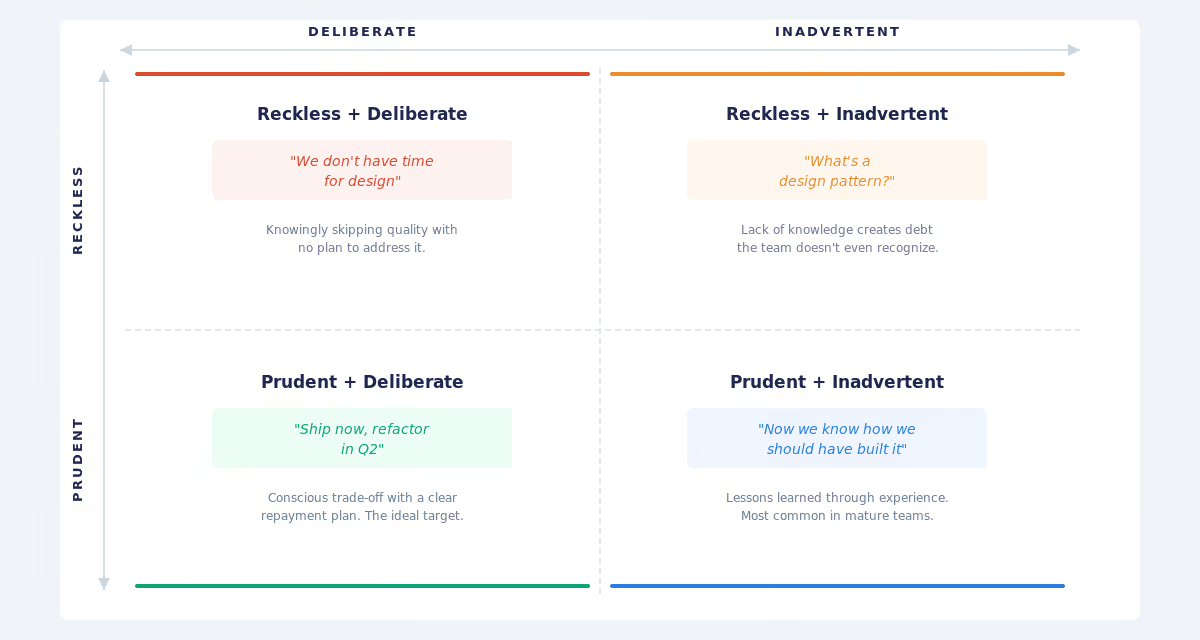
The quadrant explains how debt was incurred, but doesn't tell you which critical issues to pay down first. Not all technical debt is worth paying down. Layer in two more dimensions.
Business impact. What does this technical debt cost in dollars, latency, security vulnerabilities, time to market, or hiring difficulty? Translate the cost into a language the CFO recognizes.
Cost to fix. Not just “engineer weeks”. Include opportunity cost, coordination across development teams, and the risk of a rewrite that overshoots scope.
The third dimension most exercises miss is dependency awareness. A piece of debt with five downstream services isn't equivalent to one at a leaf node. Dependency-aware prioritization is hard in spreadsheets, which is where architecture intelligence tools like Catio come into play. When the live model of your tech stack knows what depends on what, "prioritize by blast radius" becomes a query instead of a Slack thread.
Strategies for Reducing Technical Debt Without Halting the Roadmap
Few leadership teams will sign off on stopping the product roadmap to pay down debt. The strategies that survive fit alongside delivery.
Regular code reviews and the Boy Scout Rule. Leave the code cleaner than you found it, and let regular code reviews enforce coding standards and protect code quality. Code reviews help distribute domain knowledge and catch new technical debt before it lands as bad code. This works for code-level debt and does almost nothing for architecture debt.
Dedicated debt sprints or "fix-it Fridays." A reserved time box, effective when scoped tightly, is a failure when it becomes a dumping ground for every annoyance accumulated since the last performance review.
Automated testing and fitness functions. Automated testing provides a safety net for refactoring without changing external behavior, and catches undetected bugs before they ship. Architectural fitness functions, formalized by Neal Ford, Rebecca Parsons, and Patrick Kua in Building Evolutionary Architectures, encode the properties you care about as automated checks, tests, monitors, or gates that make violations visible.
Modernization initiatives. The bigger lever when in-place fixes can't keep up. At that point, you're looking at a modernization program for legacy systems or obsolete or deprecated technologies. The principle: you can't modernize what you can't map.
Tooling-led code analysis. Static analysis tools like SonarQube and Semgrep catch code smells and other code quality problems; SAST and SCA scanners catch a subset of security issues. Architecture intelligence catches system-level coupling that others miss.
How to Build a Tech Debt Backlog That People Actually Use
The default tech debt backlog is a Confluence page from 2022 with 80 items and no owners. It's ignored because logging debt there feels like throwing it into a void.
A backlog that works has three properties. It lives where engineers work, usually as a label in the issue tracker the team already uses for new features. It captures the fields prioritization actually needs: cost to fix, blast radius, and business value. And it's groomed monthly by someone with authority to promote items into a sprint. The three levels of debt should be tagged: a "refactor this function" item and a "migrate off this deprecated payment service" item are different problems.
Architecture-Level Technical Debt: The Hidden Compounder
Most posts on reducing technical debt skip this section, and it's where most organizations lose the most velocity. Architecture debt compounds at the system level: every additional service or dependency multiplies the surface area. By the time it shows up in delivery metrics, it has usually been growing for a year.
Dependency Cycles and Fan-out Coupling
Service A calls B, B calls C, C calls A. The team that built each piece didn't know about the cycle because no one had a system-wide view. Fan-out anti-patterns are similar: a single change requires coordinated deploys across six teams, often layered on years of quick fixes.
Undocumented Contracts and Ownership Gaps
Integrations work because of behaviors no one wrote down. Services with no clear owner keep running until they break, at which point seven people on a Friday night try to figure out who knows the existing code. Zombie services are the same: deprecated systems that never got turned off because a single downstream consumer was forgotten.
How Catio Surfaces Architecture-Level Debt
These are exactly the problems Catio was built to surface. Catio's live architecture model stays grounded in what is actually running, connecting cloud infrastructure, code, configuration, services, dependencies, and environments into a single decision-ready view. Archie, our conversational architecture copilot, answers architecture questions against that live model, so tech teams can evaluate trade-offs, risks, and ROI. Architecture debt becomes manageable when the system map is current enough to support decisions.
Common Anti-patterns When Addressing Technical Debt
Several patterns reliably fail when addressing technical debt. Avoid them.
The big-bang rewrite. A team decides the only way out is to rebuild from scratch. Two years later, the old system is still in production, and the new one is half-finished. Joel Spolsky wrote about this in 2000, and it hasn't gotten less true.
"We'll fix it next sprint." Said in earnest, in every sprint, forever. Urgent demands from business teams keep crowding it out under tight project schedules, and quick fixes pile up as new features ship.
Engineering-only ownership. A debt management effort with no executive sponsor and no business case dies the first time a P0 feature ships late. It leaves new team members unable to figure out why anything was the way it was.
Reducing without measuring. You can't improve technical debt you can't measure. Tracking DORA's core software-delivery metrics (deployment frequency, lead time for changes, change failure rate, and failed deployment recovery time) gives you a baseline.
Reducing the wrong tech debt. Low-impact, easy-to-fix items get done first, while the major challenge gets deferred. Six months later, the actual cost of technical debt is unchanged.
How AI Is Changing Technical Debt Reduction
AI is changing the code-debt layer. Copilot, Cursor, and similar emerging technologies reduce the effort of common tasks like refactoring or updating dependency calls, especially when the change is local and the surrounding code has thorough testing. The risk is that AI also makes it easier to ship more code, which can exacerbate technical debt rather than reduce it. The net effect on the software development process depends on team discipline.
Architecture is where AI opens a more interesting lane. The Catio platform, recognized as Coolest Technology at VentureBeat Transform 2025, uses a multi-agent system grounded in a live digital twin to reason about architecture in context. Instead of asking a generic chatbot whether to break up a monolith, an architect can ask Archie the same question and get a response grounded in the actual dependency graph and team boundaries. As Harald Prokop, CTO of Just Appraised, put it, the value is "a neutral outsider perspective" that compresses the analysis phase.
Building a Sustainable Tech Debt Reduction Practice
A one-time pay-down is a vacation from accumulation, not a cure. A sustainable technical debt management practice rests on four best practices: metrics-driven (DORA's metrics plus debt signals), cultural (raising a debt item isn't whining), funded (a defended capacity floor), and reviewed quarterly by tech leaders.
Treat tech debt like the financial debt it's named after. The CFO doesn't stop tracking financial debt because it's uncomfortable.
Conclusion: Technical Debt Becomes Manageable When You Can See It
In conclusion, technical debt management in 2026 is less about better refactoring tools and more about better visibility. You can't prioritize debt you can't see, fund debt you can't quantify, or reduce architecture-level debt with code-level tools. The teams that get this right operate at all three layers and tie debt management to business outcomes and business goals.
If you want to see where architecture-level debt is hiding in your system before it costs you a quarter, book a demo of Catio and bring the diagrams you don't trust.
Frequently Asked Questions
What does reducing technical debt mean? It means systematically lowering the long-term cost of past shortcuts in code, architecture, and ownership. The development process involves identifying technical debt, prioritizing what to fix based on business impact and cost, and applying best practices so future development cycles aren't slowed by accumulated decisions.
How can you reduce technical debt? Combine four practices: code reviews and the Boy Scout Rule for code-level debt; automated testing and fitness functions to prevent new technical debt; architecture intelligence to surface system-level coupling; and a funded backlog. The key is a defended capacity floor that protects debt work from urgent demands.
What is the 40-20-40 rule in software engineering? A classic effort-distribution heuristic: roughly 40% of project effort goes to design and analysis, 20% to coding, and 40% to testing and integration. It's a reminder that reducing technical debt depends as much on planning and testing as on writing new code.
What are the 4 types of technical debt? Martin Fowler's quadrant provides the most-cited taxonomy: deliberate versus inadvertent, and reckless versus prudent. Four types, from "we don't have time for design" (reckless and deliberate) to "now we know how we should have done it" (prudent and inadvertent). Categorizing debt this way separates strategic trade-off decisions from accumulated mistakes.
Share this Post