August 16, 2026
What Is Software Architecture? Definition & Guide

A team ships a feature in an afternoon, then spends three weeks untangling why it broke checkout in a service nobody remembers connecting to payments. That's not a coding problem. It's an architecture problem: nobody could see the structure they were changing.
Software architecture is the answer to "how is this system actually built, and why?" It's the set of high-level decisions, structures, and relationships that determine how a system behaves, scales, and survives contact with real usage. Get it right and new features slot in cleanly. Get it wrong, and every change feels like surgery. This guide covers what software architecture actually means, why it matters, the patterns you'll encounter, and how the practice of designing and governing it is changing.
What Is Software Architecture?
Software architecture is the set of fundamental concepts and properties of a software system in its environment, embodied in its elements, their relationships to one another, and the governing principles that guide the system's realization and evolution, a definition adapted from ISO/IEC/IEEE 42010, the international standard for architecture description, now in its 2022 edition. It's the blueprint that determines whether a system can scale, stay secure, and absorb new requirements without falling apart. Architecture isn't the code itself; it's the structure the code has to live inside, along with the runtime behavior, quality attributes, and guiding principles that make that structure hold up, all covered below.
Every system has an architecture, whether or not anyone wrote it down. As software engineer Ralph Johnson put it, in an observation Martin Fowler has cited for years, architecture is "about the important stuff, whatever that is." The question isn't really whether your system has an architecture; it's whether anyone can describe it accurately, or whether it only exists as tribal knowledge in three people's heads.
Why Software Architecture Matters
Architecture decisions are expensive to make and even more expensive to unmake. A naming convention is a five-minute fix. A decision to couple your billing service directly to your user database is a multi-quarter migration once you notice it's a problem. That asymmetry is a big part of why architecture gets treated as a discipline instead of an afterthought.
Good architecture shows up in things teams actually feel day to day: how fast a new engineer can ship their first real change, whether a traffic spike degrades gracefully or takes down checkout, and whether "add one more field" takes an hour or a sprint. Scalability, maintainability, and reliability aren't abstract qualities; they're the direct output of decisions made (or skipped) at the architecture level.
The cost of getting architecture wrong
Bad architecture doesn't announce itself; it shows up as technical debt: workarounds stacked on workarounds until the system fights back against every change. A monolith with no clear module boundaries turns a two-line bug fix into a full regression cycle because nobody can prove what else the change touches, and every incident review ends with some version of "we didn't know that was connected."
The cost compounds. Fixing bad architecture after the fact usually means a rewrite, and rewrites are where roadmaps go to die.
What good architecture enables
Good architecture is what lets a team move fast without breaking things they can't see. Clear service boundaries mean a team can deploy independently instead of coordinating a release train. Well-defined interfaces mean a new hire can change one component without reading the entire codebase first. Explicit quality attributes, like knowing your system needs to handle 10x traffic during a seasonal spike, mean that capacity planning happens before the spike, not during the incident.
None of this eliminates trade-offs; it just makes them visible and deliberate instead of accidental.
Software Architecture vs. Related Concepts
These terms get used interchangeably, which causes real confusion in planning conversations. Software design is the detail level below architecture: class structures, algorithms, and function-level decisions inside a single component. Architecture decides how components fit together; design decides how each one works internally.
System architecture is broader, spanning hardware, networking, and infrastructure alongside software, not just the application layer. If you're weighing load balancers or data center topology alongside service boundaries, you're in system architecture territory.
Enterprise architecture zooms out further, aligning technology structure with business strategy across an entire organization rather than one system. Solution architecture sits in between: the architecture of a specific solution built to solve a specific business problem, bridging enterprise strategy and software-level design. These are practical distinctions, not fixed boundaries: enterprise architecture programs often fold in application-level decisions, and solution architecture overlaps heavily with software or system architecture depending on the organization.
Core Elements of Software Architecture
Strip away the buzzwords and software architecture comes down to three things: what the system is made of, how it behaves, and what quality bar it has to clear.
Structure
Structure is the components and the connections between them: services, modules, databases, and the interfaces that let them talk to each other. A component's interface is a contract. Change the contract and every dependent component potentially breaks, which is why interface stability matters more than internal implementation details.
Behavior
Structure describes what exists; behavior describes what happens when the system runs, including request flows, event sequences, and failure modes: what happens when a downstream service times out, or two writes race against the same record. A diagram of boxes and arrows tells you almost nothing about behavior. You need to know the order things happen in and what happens when they happen out of order.
Quality attributes and non-functional requirements
Quality attributes are the non-functional requirements that decide whether an architecture actually works in production, not just on a whiteboard:
- Scalability: can the system handle 10x load without a full rewrite
- Security: how is data protected in transit, at rest, and across trust boundaries
- Availability: what happens when a dependency goes down
- Performance: response time and throughput under realistic load
- Maintainability: how much effort does a change take six months from now
- Testability and observability: can you verify the system behaves correctly as it changes, and can you tell what it's actually doing once it's running
- Interoperability and modifiability: how well it exchanges data with other systems, and how easily it absorbs new requirements without a rewrite
Architectural views and documentation exist to make these elements legible to people who didn't build the system: a logical view for components, a deployment view for infrastructure, a process view for runtime behavior. Frameworks like the TOGAF Standard, now in its 10th edition, formalize this at the enterprise level; lighter, non-standardized notations like the C4 model do the same for a single system, giving teams a shared vocabulary instead of everyone inventing their own boxes and arrows.
Common Software Architecture Patterns
Most systems in production use some combination of a handful of well-established patterns. None of these are universally "correct." Each one trades simplicity for flexibility somewhere, and the trade only makes sense once you know what you're optimizing for.
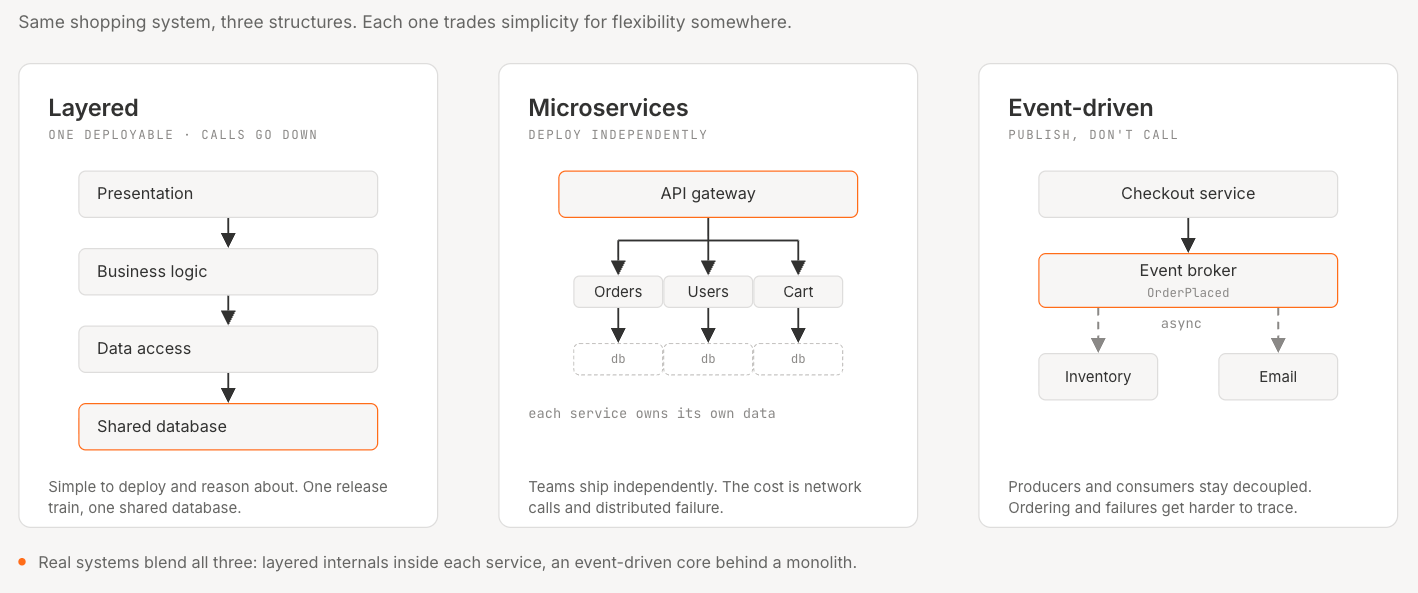
Most real systems aren't a pure implementation of any single pattern. A microservices system usually has layered internals inside each service, and a "monolith" often has an event-driven core handling background jobs. The pattern names are a vocabulary for describing trade-offs, not a checklist to follow exactly.
How Software Architecture Is Designed
Architecture design isn't a single meeting where someone draws boxes on a whiteboard and everyone agrees. Carnegie Mellon's Software Engineering Institute and the broader academic literature commonly describe it as an iterative cycle of four activities: analysis, synthesis, evaluation, and evolution.
Architectural analysis starts with requirements, both functional (what the system must do) and non-functional (how well it must do it), and identifies the constraints that shape every decision downstream: existing systems to integrate with, compliance requirements, team skill sets, deadlines.
Architectural synthesis is the actual design work: proposing structures, choosing patterns, and defining how components interact based on what analysis surfaced. This is where the patterns from the previous section get selected and combined.
Architecture evaluation stress-tests the proposal before it's built, not after. Structured methods like the Architecture Tradeoff Analysis Method (ATAM), developed by Carnegie Mellon's Software Engineering Institute, walk through quality-attribute scenarios, what happens under peak load, and what happens during a partial outage, to surface risks while they're still cheap to fix. In practice, most teams never run a formal ATAM session, but the underlying discipline is worth borrowing informally.
Architecture evolution is the part most teams underinvest in. Requirements change, traffic patterns shift, and the system that was correctly architected at launch drifts from what's actually needed eighteen months later. Treating evolution as a first-class activity, not a failure of the original design, is what separates architecture that ages well from architecture that quietly rots. Software architecture tools that support this full cycle, not just the initial diagramming step, make analysis and evaluation repeatable instead of one-time events.
Who Owns Software Architecture Decisions?
Architecture decisions typically sit with a software architect or a senior engineer acting in that capacity, but they rarely happen in isolation. Product, security, infrastructure, and the engineers who'll actually build the thing all have a stake, which is why teams increasingly document decisions as architecture decision records (ADRs): short, dated records of what was decided, why, and what alternatives were rejected. An ADR only stays useful if it's linked to the code, service, or team that owns it, and revisited when assumptions change; otherwise it becomes one more stale document. Architecture governance, the ongoing process of keeping decisions consistent and enforced as a system grows, matters just as much as making the decision in the first place.
How AI Is Changing Software Architecture
Most architecture practice still treats a decision as a one-time event: draw the diagram, write the ADR, move on. The diagram is accurate on the day it's drawn and stale within a quarter, because nobody goes back to update it once the system starts changing underneath it. That gap between the architecture teams think they have and the one actually running in production has a name: architecture drift, or architecture erosion.
A new category of AI-native architecture tooling and practices is emerging specifically to close that gap, treating architecture as something to observe and govern continuously instead of designing it once. We built Catio, an AI-native architecture decision platform, as one example of that shift. Rather than a static diagramming tool, we work from a live model of a team's actual systems, though that model is only as complete as what's connected to it: unconnected repos, shadow integrations, manually configured cloud resources, and undocumented SaaS flows can still fall outside its view. Archie, our reasoning agent, works through architecture questions step by step using real data pulled from a team's connected environments instead of just general knowledge. We also surface architecture drift directly, flagging where a system's real structure has moved away from its intended design to help teams catch drift earlier. Coding agents and IDEs increasingly connect to external context through the Model Context Protocol (MCP), which lets us expose live architecture context to compatible clients like Claude Code and Cursor, or to VS Code through a supporting extension, though whether that context actually shapes what gets built still depends on the client's permissions and the workflow, not something MCP enforces on its own.
This doesn't make lightweight documentation obsolete. Most teams start with ADRs and hand-drawn diagrams, and that's the right call: a small system with three engineers doesn't need continuous drift detection. Tools built for continuous governance earn their place once a system and its team outgrows what a static document can realistically track, which for most companies happens sooner than anyone planned.
Conclusion
Software architecture is the set of high-level decisions, structures, and relationships that determine how a system behaves, scales, and evolves, and getting those decisions right (or wrong) shapes everything a team builds on top of them. The discipline itself is shifting: architecture is moving from a document you write once toward a system you observe and govern continuously, with AI-native tools increasingly catching drift between what a team designed and what's actually running.
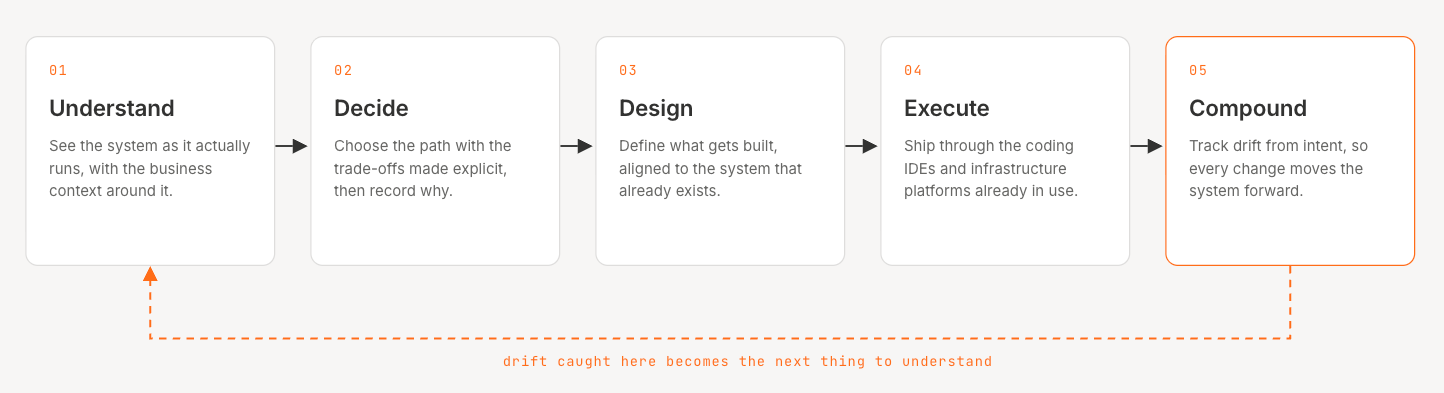
If you're evaluating how to keep architecture decisions current as your systems grow, our platform is built around exactly that continuous decision cycle, from understanding your current architecture through catching drift earlier, before it turns into a bigger problem.
Frequently Asked Questions
What is an example of software architecture? A ride-sharing app is a practical example. It typically separates into a mobile client, an API gateway, a matching service that pairs riders with drivers, a payments service, and a location-tracking service that ingests GPS data continuously. Each is a distinct architectural component with its own responsibilities, data, and failure modes; the architecture is the set of decisions about how they connect and what happens when one fails.
What are the types of software architecture? There's no single official count. Software architecture is more commonly organized by pattern (layered, microservices, event-driven, and so on, covered above) than by a fixed number of "types." That said, three broad structural categories come up repeatedly in practice: monolithic (a single deployable unit), client-server (a central server handling requests from distributed clients), and distributed (microservices and event-driven systems where responsibility is spread across independently deployable components). Most real systems blend elements of more than one.
What skills are needed for software architecture? Strong architects combine deep technical breadth (distributed systems, data modeling, security, infrastructure) with the non-technical skills that keep decisions from becoming purely academic: communicating trade-offs to stakeholders, documenting decisions clearly enough that someone else can follow the reasoning a year later, and the judgment to know when "good enough" beats "theoretically correct."
Share this Post