September 4, 2026
Architecture Management: Turning Static Diagrams Into a Living Practice

Architecture management, in the software sense, is the practice of keeping an organization’s technology architecture understood, governed, and current as it changes. It is not the business of running an architecture firm, which is what most of the internet means by the phrase.
That disambiguation matters, because the software version of the term has a credibility problem of its own. In many organizations, architecture management amounts to a diagram, a wiki page, and a quarterly review board. Each was accurate on the day it was made and unverified after that. This piece covers what the practice involves and which standard frameworks address the maintenance problem. Then it covers why the documentation-first version keeps failing, and the one question that separates a practice which stays true from one that only looks like it.
What Architecture Management Actually Means (and Why the Term Is Confusing)
Architecture management is the ongoing work of maintaining a shared, accurate picture of how an organization’s systems fit together, and using it to govern how they change.
Enterprise architecture is the broader discipline it belongs to. NIST’s glossary entry is built around three pieces: a baseline architecture, a target architecture, and a sequencing plan between them. Architecture management, as we use the term here, is the operational emphasis inside that. It means keeping the model current, running decisions through it, and catching where the built system has moved away from the intended one.
That is our working distinction rather than a field-wide one. Some organizations call the whole thing enterprise architecture management and run it as a single function, which is fine as long as the operational half does not quietly disappear.
Not to Be Confused With Architectural (Firm) Management
Search the term and Google hands you salary questions, degree questions, and software for running an architecture practice, because a different profession got there first. Everything below concerns IT architecture management in the sense we set out in our piece on IT architecture: cloud estates, services, data flows, and the decisions that reshape them.
Why Traditional Architecture Management Breaks Down
At any meaningful scale, the standard setup has three parts. A diagram or model of the current state, a set of standards describing what good looks like, and a review board that checks proposals against both. All three are reasonable, and only the third has a heartbeat.
Diagrams are the clearest example. A diagram is a snapshot of an opinion, and it starts diverging from the running system the moment somebody merges a change nobody thought to redraw. Nothing announces this, and it looks as authoritative on day two hundred as on day one. We took that divergence apart in our piece on configuration drift.
Spreadsheets tracking the application portfolio decay the same way, and so does tribal knowledge, which leaves when its holder changes teams. What follows is worse than a documentation gap, because decisions get made against the stale picture. Somebody scopes a migration from a model eighteen months out of date, and the gap surfaces during delivery, after the budget is committed.
The tell that this has already happened is not that documentation is missing. It is that engineers have quietly stopped consulting it. When the reliable way to answer a current-state question is to open the cloud console and read the running configuration, the wiki has already lost. Buying a more expensive wiki will not win it back.
The Core Practices of Architecture Management
Underneath the tooling argument sits a body of practice that is genuinely stable and worth being precise about.
The Four Domains
Practices commonly organize architecture into four layers: business (capabilities and business processes), data (what information exists and who owns it), application (the software portfolio and how systems interact), and technology (the infrastructure underneath). That split is TOGAF vocabulary and useful shorthand rather than a universal taxonomy, since other frameworks classify differently.
The application layer is where day-to-day effort tends to concentrate, which is why application portfolio management is often the first discipline a growing organization formalizes.
Frameworks Teams Reference
Two widely used frameworks address different parts of this question.
TOGAF is a method rather than a classification alone, and it already contains the maintenance problem. Its Architecture Development Method runs as a cycle, and two of its phases are named for exactly this work. The Open Group’s own mapping of ArchiMate to TOGAF lists “Phase G: Implementation Governance” and “Phase H: Architecture Change Management” alongside the earlier architecture phases. Anyone claiming the established frameworks ignore lifecycle and governance has not read them.
The Zachman Framework is a different kind of artifact. It is a classification schema rather than a method. It tells you what to describe and whether you have described all of it, not how to keep it true, and Zachman International is direct about the limit: “A Structure is NOT a Process.”
The gap is not that the frameworks lack a lifecycle, because TOGAF has one. The gap is what feeds it. A governance phase still needs a current-state picture to govern against, and the frameworks are deliberately silent on where that picture comes from.
Who Owns It
Ownership is usually split, and the split is where things break. In the common arrangement, an enterprise architect owns the cross-cutting view and the standards. A system architect or principal engineer owns specific designs, and platform teams own the infrastructure the model describes.
That distribution helps explain why documentation-first practices decay. The person with authority to maintain the central model usually isn’t the first to learn it’s no longer true. The practice then depends on a handoff nobody is measured on.
From Static Documentation to a Living Practice
Continuous architecture management is already part of established frameworks. The practical question is how the current-state model stays accurate between reviews.
TOGAF has run architecture as an iterative cycle for years, with Phase G: Implementation Governance and Phase H: Architecture Change Management doing exactly this work. Teams can pair that lifecycle with human review gates and automated checking.
So the real question is narrower and more useful: what closes the loop?
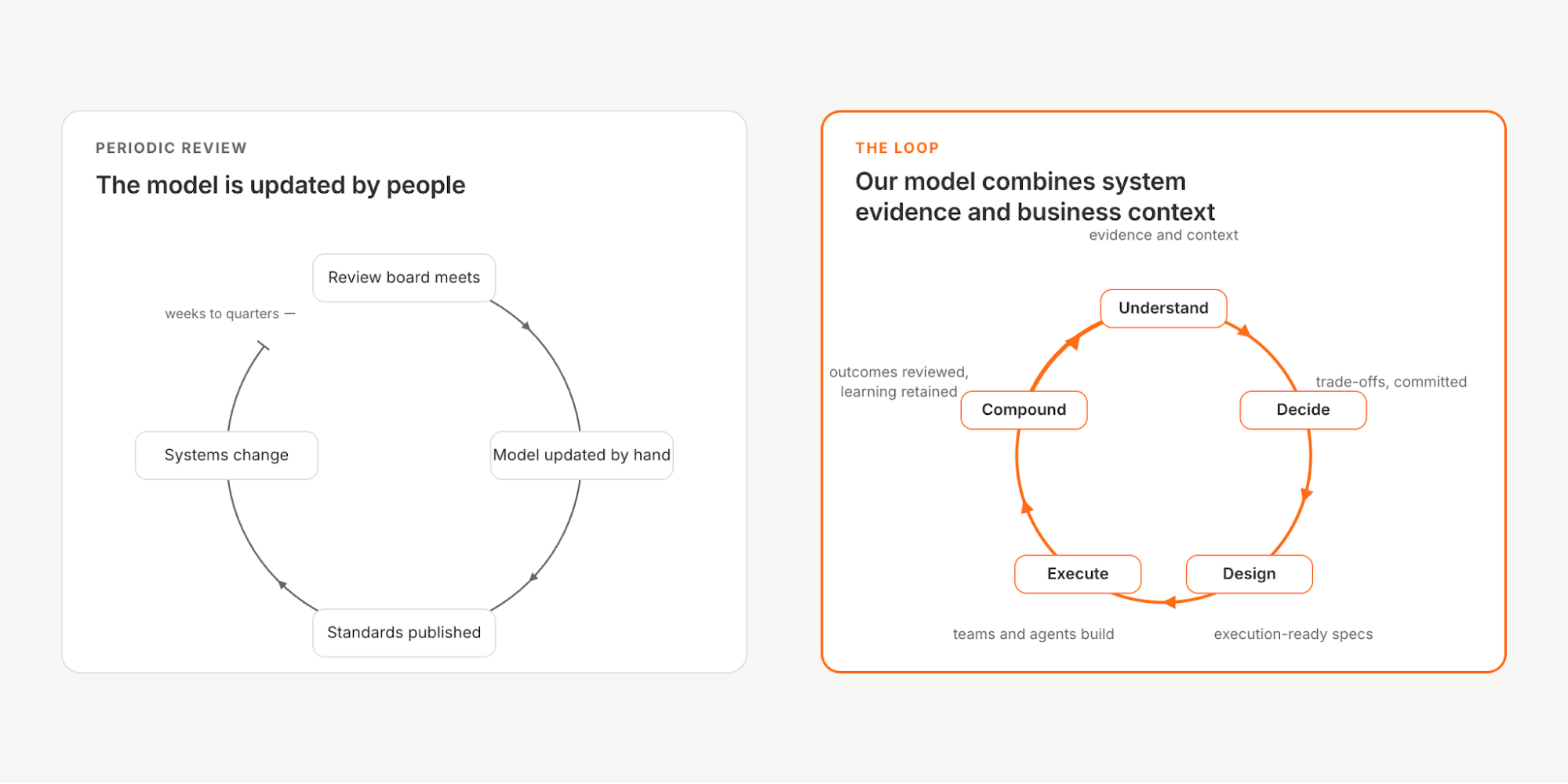
In the periodic-review model, a human closes it. Somebody schedules the evaluation, somebody updates the documentation, somebody notices that reality moved. Continuous improvement there means committing to manual work on a cadence. Plenty of organizations run that well, but accuracy is bounded by how recently a person last looked, and the interval between looks is where drift lives.
We built our methodology the other way round, deriving the current-state picture from the running system so closing the loop is not an act of discipline. Our loop has five phases: Understand, Decide, Design, Execute, Compound. Understand is a live model built from your code, cloud configuration, and observability data. Decide weighs trade-offs and commits to ROI; Design turns that choice into execution-ready specifications; and Execute is where teams and coding agents build against them.
Compound closes the learning cycle: teams review what changed, compare outcomes with the decision’s intent, and feed the findings back into Understand. Our role is to preserve architecture context for the next decision. Your teams investigate exceptions and implement corrections through their existing tools; we do not operate, monitor, or enforce runtime systems.
None of this removes human judgment. Deciding is still a person’s job, and so is knowing which trade-off the business can absorb. What changes is where the picture comes from: views update automatically as integration data is ingested, so nobody has to remember to redraw them. Two boundaries still apply, and we would rather name them. Your subscriptions determine what is in scope, and ingestion cadence determines how fresh it is. That is a different failure surface from a stale diagram, not the absence of one.
How We Ground “Understand” in What Is Actually Running
A loop is only as good as the phase that feeds it, which puts the weight on Understand. We built Stacks to model the infrastructure that actually exists before overlaying the logical systems people drew. We called that physical-first in our write-up on modeling AWS infrastructure, where we argued that conventional diagrams reflect intentions more than actual systems, and the gap between design and reality gets expensive as the estate grows. Physical-first inverts the order, starting from the infrastructure nobody can argue with.
The inventory then answers questions a logical model cannot. A logical view tells you a payments service exists. A physical one tells you which region and availability zone it runs in, what it connects to, and what the configuration said at the last ingestion.
We capture proposed changes in Blueprints: structured artifacts that connect the current state, the target, and an implementation path. A prompt can produce a Design, a Recommendation, or a Plan, with the artifact type classified automatically. Our shorthand is that a Blueprint is a pull request for your architecture: a proposal the team can review before executing it in its existing tools.
Two limits belong alongside that. First, our model depends on the sources and context you provide, so unrepresented systems and missing business constraints can leave gaps. Keep an explicit record of what is covered and revisit it when the sources change. Second, freshness depends on successful ingestion. We work with teams beyond AWS-only estates; confirm the integrations and evidence coverage available for your environment.
What to Look For in an Architecture Management Practice
Whether you are evaluating a tool or auditing the practice you run, four questions do most of the work, for a vendor and for your own wiki alike.
Where does the current-state picture come from? If the answer is that someone maintains it, everything downstream is bounded by that person’s attention, which may be acceptable but should be a decision, not an accident.
How would you find out the model is wrong? “We would notice eventually” is not a mechanism.
Is the reasoning behind decisions retrievable? Somebody will eventually ask why the payments service talks to the warehouse database. If the answer lives in a Slack thread, you have structure without memory.
Does it produce something a team can build from? A diagram is not an implementation plan, a case we made in our piece on architecture diagrams. Target state, the gap against it, and a sequence someone can execute is a different artifact, and the one that survives contact with a delivery team.
Conclusion
The useful reframe is not that architecture management should be continuous, because that argument has mostly been won. It is that continuity has to come from somewhere, and a practice that depends on people remembering to refresh the picture will be exactly as current as the last time somebody remembered.
Take a decision you are facing right now, time how long it takes to answer the current-state question underneath it, and see how much you trust the answer. That number tells you more about your practice than a framework audit will. If the answer took too long, start a real architecture decision against your own estate rather than against a diagram.
Frequently Asked Questions
What is the difference between architecture management and enterprise architecture?
Enterprise architecture defines the target architecture across business, data, application, and technology layers. Architecture management is the operating half: keeping the model accurate and governing change against it. Many organizations combine both, which works as long as the maintenance half gets real ownership.
Who is responsible for architecture management on an engineering team?
Usually shared, which is the source of most of the trouble. An enterprise architect owns standards and the cross-system view; a system architect or principal engineer owns specific designs. The practice fails at the handoff, so name who is accountable for the model being true.
How is architecture management different from documentation?
Documentation records a decision. Architecture management governs the relationship between the intended architecture and the built one, including noticing when the two separate. A practice that produces documents and never checks them against what is running is doing half the job.
Does architecture management require a dedicated tool?
No. Small estates run it well with a diagram and a disciplined review cadence; we surveyed the wider enterprise architecture tools landscape separately. The honest test is whether that has held for you. If you have built a current-state model twice and watched it go stale both times, that is evidence.
Share this Post