September 7, 2026
Architecture Strategy: Connecting Business Goals to Technical Decisions

Most engineering organizations of any size have something they call an architecture strategy. Far fewer can answer a simple question about any given decision: which business goal did this serve, and what did we give up to get it?
That gap is the subject. Stating a strategy is easy, and every guide will tell you to align technology with business objectives. The harder problem is traceability: keeping the link between a goal and a decision intact from the offsite where the goal was set to the sprint where somebody acts on it.
What Is Architecture Strategy, and Why It Is a Business Decision
Architecture strategy is the plan connecting an organization’s business goals to the shape of its technology. It names the capabilities the systems must support, the target architecture, and the trade-offs the organization has agreed to accept. It sits above any single system and below the business strategy driving it. The discipline it belongs to is enterprise architecture, which NIST’s glossary frames as a strategic information asset base defined by the mission it exists to perform.
The word “business” is doing real work there. An architecture decision is a resource-allocation decision wearing technical clothes: extracting a service, standardizing a runtime, or staying on a monolith each commit engineering months that could have gone elsewhere. The case for any of them rests on a business goal, a forcing function nobody chose (like a vendor end-of-life), or preference. The first two give a budget owner a reason to fund the work.
This is also why architecture strategy is not the same thing as system architecture, which we covered in our piece on how a single system gets designed. Strategy governs which systems should exist, in what shape, and why.
Why Architecture Strategies Break Down Before They Reach Engineering
Strategies rarely fail at the strategy stage. They fail in transit.
The typical artifact is a deck, produced during a planning cycle and shared once. It states principles that are reasonable in the abstract: reduce coupling, standardize the runtime, move toward event-driven integration. Then it goes into a drive, and the organization starts making decisions.
Three things happen to it. The strategy stops matching the estate, because it was written against a picture that was already weeks stale, and every release since has widened the gap. The rationale evaporates, so six months later nobody can say why the payments service talks directly to the warehouse database. The trade-offs never get recorded, so the reason a rejected alternative lost is unrecoverable and the argument gets relitigated.
The compound effect is that architecture stops being decided and starts being accumulated. The current state is the residue of a hundred local choices, each defensible alone, none checked against the strategy meant to govern them.
Your own technical debt backlog helps measure the cost: of the remediation work queued up now, how much is fixing a decision, and how much is working out why the decision was made?
The Core Components of an Architecture Strategy
Strip away the framework vocabulary and a working architecture strategy carries four things. It states the business goals it serves, pictures the current state honestly, describes the target state, and names the trade-offs accepted along the way.
The Four Architecture Domains
Practices commonly organize the target state across four domains. Business architecture covers capabilities and processes, data architecture covers what information exists and who owns it, application architecture covers the software portfolio, and technology architecture covers the infrastructure underneath. Treat the split as one convention among several, useful mainly for dividing the work.
The domains do not tell you where the pressure is, and in practice one or two dominate at a time. The useful question is which domain the next twelve months of change will land in.
Where Frameworks Fit, and Where They Stop
The Open Group’s TOGAF is the closest thing the field has to a default, and we surveyed the wider landscape in our guide to enterprise architecture tools. Frameworks give you shared vocabulary, a structure for the target state, and a defensible process for reaching one.
They also carry more traceability machinery than they get credit for. TOGAF and ArchiMate are built to work together, so a line runs from drivers and goals through capabilities and architecture to the work packages that implement them. TOGAF’s governance phase exists to hold implementation to the architecture that was agreed.
So the gap is not a missing traceability structure. It is that the structure gets maintained by hand, against a current state nobody re-derives between planning cycles. What we think is missing is a reviewable decision artifact generated against connected architecture state and recorded context, so the trace falls out of the decision rather than becoming a separate modeling exercise.
From Business Goals to Technical Decisions: Tracing the Line
Teams can connect technical work to business outcomes in a strategy document. The maintenance problem is keeping that trace accurate as goals, systems, and decisions change.
The version that survives works like this. A decision starts from a stated goal. Its options get evaluated against the state as it actually runs, not as it was last documented, and the trade-off is recorded when it is made, including what was rejected and why. All of that stays attached to the decision as a durable object instead of dispersing into a deck, a Slack thread, and somebody’s memory.
Two of those steps are harder than they look. Evaluating options against the running estate means having a current picture of it, and the gap between the documented estate and the real one is what we’ve called configuration drift. Recording the trade-off means having somewhere durable to put it, which is not a channel and not a slide.
Turning Strategy Into a Living Artifact
We built our platform around this problem, so it is worth being concrete about what we do and where it stops. Our methodology runs as a loop: Understand, Decide, Design, Execute, Compound. Architecture strategy lives in Decide, where you evaluate trade-offs and commit to ROI-optimized choices, and two things make that phase produce something durable.
The first is Context, which is where the goals live. It has three parts. The objective is what you are trying to achieve and what you will not trade off. The constraints are the system as it actually runs, and this is the part you do not supply, because it flows in live from your integrations and Stacks. The steering is where an architect encodes standards, approved patterns, settled trade-offs, and the paths your organization has ruled out. Only the first and third are things you write.
An empty Context is not a neutral starting point. It is a workspace where every output is optimized toward something you never chose.
The second is the Blueprint, which is where a decision lands. A Blueprint carries the change from current state to target state alongside the reasoning, the surrounding business context, and the implementation path, so the argument never gets separated from the plan. A prompt can produce a Design, a Recommendation, or a Plan, with the artifact type classified automatically. We think of it as a pull request for your architecture, with the Gap Analysis section as the diff: what is missing, misconfigured, or no longer fits, stated as a specific delta.
Recommendations and Designs use seven sections: Summary, Benefit, Impact, Target State, Gap Analysis, Business Impact, and Implementation Plan.
The mechanism that answers this article’s question is easier to miss. Every Blueprint carries a Context Summary listing the context entries that informed it. That is the traceback: not a claim that the decision aligned to strategy, but a record of which stated goals were in scope when it was made.
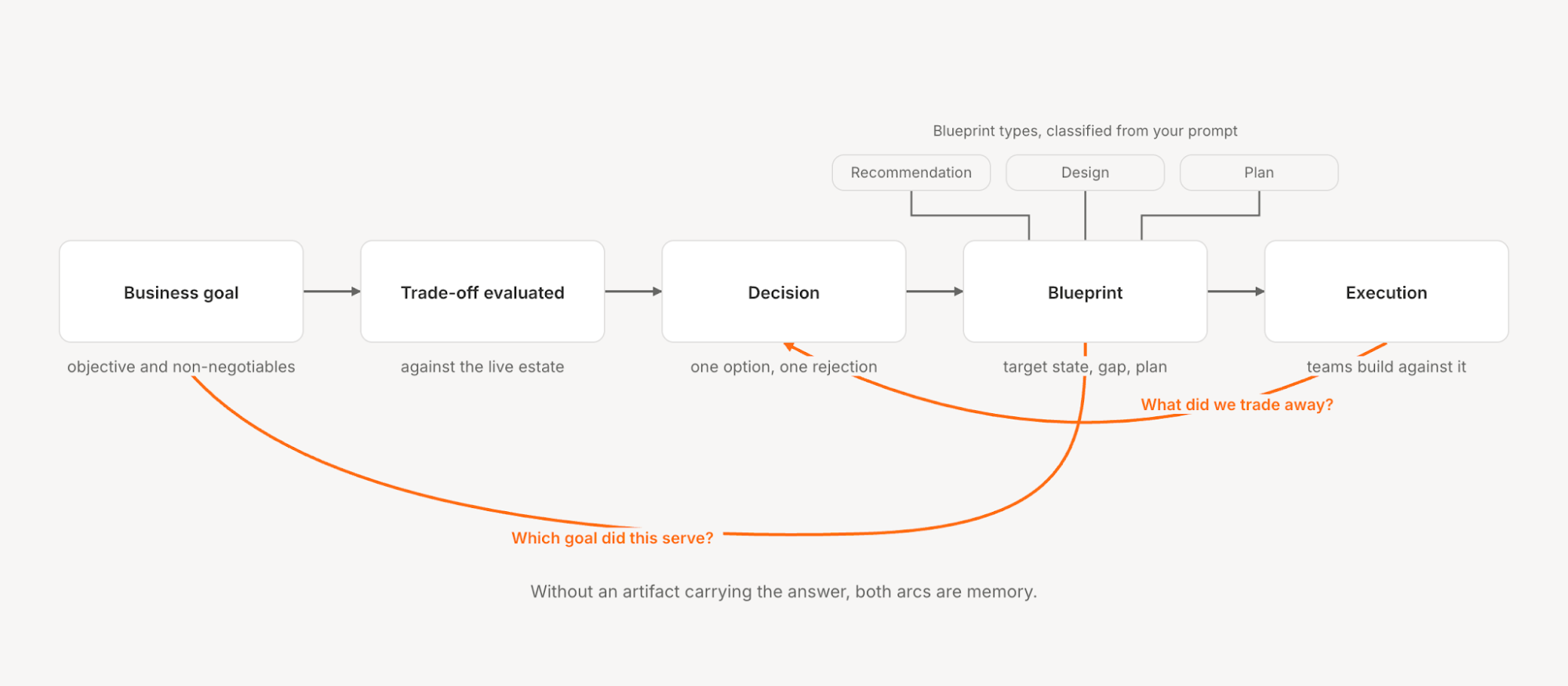
What a Blueprint buys over a deck is consistency. The decision and its argument stay in one artifact, generated against the same Context every time, so two Blueprints reach for the same standards instead of two different opinions. Currency comes from elsewhere, because half of Context is not a document anyone maintains.
Three limits, since we have spent this whole piece arguing that artifacts go stale. A Blueprint is generated by a multi-agent AI system, so it is a starting position to argue with, not a record of what a human already concluded. It is also not committed work, because in the pull request analogy, the merge is adding it to a Plan. Archie can propose an order; committing to that sequence stays a human act.
The third limit is ours to own. Our analysis is bounded by the sources and context you provide, and we work with architecture teams beyond AWS-only estates; you’ll need to confirm available integrations and evidence coverage for your environment. We are a decision and design layer, not an observability tool.
How to Keep an Architecture Strategy Alive Through Execution
Four principles, none of which need a tool to start.
Run two clocks. Goals and accepted trade-offs move at the pace of the business, so revisiting them a couple of times a year is defensible. The current state they are measured against moves at the pace of delivery. Reviewing both on the slow clock leaves the strategy judged against an out-of-date picture. AWS makes a version of this point in its Well-Architected review process, which treats a review as a light, blameless conversation held at milestones rather than an annual audit.
Name someone accountable for the strategy still being true. Ownership usually splits between engineering leadership, who own resourcing, and architects, who own the technical shape. That split is fine. What goes missing is a named owner for currency, which is a different job from owning the strategy’s existence.
Record the rejected option, not just the chosen one. A decision without its discarded alternative is only an instruction. With the alternative and the reason it lost, a future team can reopen it honestly instead of relitigating from scratch.
Test the trace on decisions you already made. Pick three decisions from the last quarter and name the business goal each served and the alternative each rejected. If those answers are hard to recover, the decision record needs work.
Common Pitfalls That Undermine Architecture Strategy
Three common failure modes undermine that traceability.
Strategy written in isolation from the business. A technically immaculate target state with no business sponsor is a document, not a strategy. The test: can you name the person outside engineering who would defend it if it got expensive?
Goals stated at a level that cannot be traded off. “Improve scalability” cannot lose an argument, which makes it useless as a goal. “Support 4x order volume by Q3 without increasing per-order infrastructure cost” can be traded against something, which makes it real.
Confusing a roadmap with a strategy. A sequence of projects is an output of strategy, not a substitute for it. If the roadmap changes and nobody can name the principle the change violated, there was no strategy underneath it.
Conclusion
An architecture strategy is real to the extent it can answer two questions about any decision: which goal did this serve, and what did we trade away? A third question, how far the current state has drifted from where you said you were going, decides whether those answers are still true.
Run the traceability test this week on decisions you already made. If the answers aren’t there, your strategy probably isn’t wrong; nothing is carrying it forward, and that is the problem our platform is built around.
To see what that looks like against your own estate, book a demo.
Frequently Asked Questions
How is architecture strategy different from enterprise architecture?
Enterprise architecture is the discipline: the practice, models, governance, and frameworks. Architecture strategy is the directional part, meaning the choices about where the architecture is going and what will be traded off to get there. An EA function can produce careful documentation and still have no architecture strategy at all.
How often should an architecture strategy be revisited?
Run the two clocks described above: goals move at the pace of the business, the current state at the pace of delivery.
Who owns architecture strategy?
Engineering leadership and architects usually share it, which works. The gap is unnamed accountability for the strategy still being true.
How do you measure whether an architecture strategy is working?
Counting completed initiatives measures activity rather than strategy. Use the traceability test above: for a handful of recent decisions, can you name the goal served and the alternative rejected?
Share this Post