September 10, 2026
Enterprise Architecture Management: What It Takes Now

Most enterprise architecture management programs don’t get canceled. They get ignored. The repository stays online, and the annual review still happens. Teams ship against whatever they can see in the code, because the model in the tool stopped describing the running system months ago.
Enterprise architecture management (EAM) is the practice of maintaining a current view of an organization’s systems, dependencies, and standards, and using that view to govern how the estate changes. The discipline is sound, and so are the frameworks. Most organizations inherited an operating model alongside them, built for a rate of change that no longer exists.
This guide covers what EAM actually means, why the survey-and-repository version of it breaks, what a continuous alternative looks like in practice, and how to evaluate tooling against it. It’s written for CTOs, VPs of Engineering, and architects who already have an EAM function and can tell it isn’t keeping up.
EAM’s Reputation Problem
Ask an engineer what EAM means, and you’ll usually get a description of paperwork. A repository nobody opens. A review board that adds two weeks to a project. A diagram that was accurate on the day it was drawn.
Governance and documentation alone do not show how a decision was made or when to revisit it. A useful EAM practice keeps that reasoning attached to the decision.
The underlying work is real. Somebody has to know what runs where, what depends on what, and which of the four competing message queues new services are supposed to use. Most practices were built to answer those questions on a quarterly cadence, and the systems they describe now change daily.
What Enterprise Architecture Management Actually Means
Strip out the governance vocabulary, and EAM does three things. It maintains a description of the current estate. It defines the target state and the principles that get you there. And it manages the gap between the two as work gets scheduled and shipped.
Everything else follows from those three. Standards exist so the gap doesn’t widen accidentally. Review boards exist because somebody has to catch changes that widen it deliberately. Business architecture sits alongside EAM to explain why any of it matters commercially, and application architecture sits under it to describe how individual systems are built.
Frameworks formalize this. The Open Group’s TOGAF Standard, now in its 10th Edition, is built around the Architecture Development Method, a method for developing and managing an architecture’s lifecycle rather than producing documents about it. That distinction is worth holding onto: lifecycle management, not documentation production. The frameworks were never the problem.
Why the Traditional Model Breaks Down
The traditional operating model assumes a specific relationship between the model and the system. You survey the estate, you write it down, and the writing stays roughly true until the next survey. That assumption held when standing up a new environment took a purchase order and six weeks. It doesn’t hold now, for three reasons that compound.
The Estate Got Bigger and More Granular
In the CNCF’s 2025 annual survey, published in January 2026, 82% of container users reported running Kubernetes in production, up from 66% in 2023. An estate that a single architect could once hold in their head as a list of applications is now a set of workloads too large for anyone to hold. Each workload carries its own configuration and blast radius.
The layers also age at different speeds. Business architecture, meaning the capabilities and processes the organization actually performs, changes over quarters and years. The technology underneath it now changes over days. Surveying both on one annual cadence guarantees that half the model is stale by the time it’s published.
The Rate of Change Went Up
Google’s DORA research put AI adoption among software development professionals at 90% in September 2025, a 14% increase over the previous year. It also found that adoption is now linked to higher software delivery throughput. These numbers continued to rise through 2026.
Volume alone would be manageable. The harder problem is what the output looks like. In the 2025 Stack Overflow Developer Survey, “AI solutions that are almost right, but not quite” was the most commonly reported frustration among developers using AI tools, cited by 66% of them. Neither survey measures architectural conformance, and it would be a stretch to claim they do. But “almost right” is a recognizable failure mode for anyone who has reviewed a system: code that is locally correct and systemically wrong. A reviewer checking a diff for logic and style has no way to see that a new service just opened a second write path to a database that was supposed to have one. Not unless that constraint is written down somewhere the reviewer can reach.
The Cost Shows Up in the Budget, Not in an Outage
McKinsey’s May 2025 analysis, citing Gartner, reports that 79% of IT spend goes to operating expenditure. It also estimates that addressing tech debt adds 10 to 20 percent to project costs. Architecture decisions can influence that burden, and they’re being made continuously whether or not the practice is present when they happen.
The Real Goals of an EAM Practice
The standard goal list is fine as far as it goes: alignment, risk management, standardization, future-proofing. Each item changes meaning once you accept that the estate moves faster than the survey cycle.
- Alignment: becomes a question you answer on demand rather than a document you sign. This is where EAM meets business architecture, because the question isn’t whether a change is technically sound but whether it serves a capability the business actually needs.
- Risk management: becomes detection at the point of change rather than a register reviewed quarterly. A dependency introduced on Tuesday is cheaper to unwind on Wednesday than in next year’s audit.
- Standardization: stops meaning a catalog of approved technology and starts meaning the deviations are visible and deliberate.
- Future-proofing: changes least of the four, and still depends on a current-state picture that is real.
None of that argues against governance. It argues that governance has to run at the speed of the thing it governs.
From Static Documentation to a Compounding System
The alternative to a periodic survey isn’t a better survey. It’s a model that maintains itself from the system it describes.
Any tool built on that premise has to do two things: connect to the running environment rather than ask you to describe it, and treat prior decisions as data rather than as history. That is what we built. We build our architecture model by connecting read-only to the environment itself, taking in cloud accounts, Kubernetes, and VPC flow logs alongside source code and data flows. Stacks models the architecture from subscribed integrations, with no manual modeling required. How much of that model a tool builds for you, and how much you maintain by hand, is the trade-off worth testing in an evaluation rather than taking on faith.
That shift changes what the rest of the practice can assume. When you rebuild the current-state model from the environment rather than a survey, architecture drift becomes something you detect rather than something you discover. Drift here means divergence between what was implemented and what was intended, and we only detect it as far as the boundary of what you have connected. We call the same idea architecture memory: decisions persisting as system context rather than scattering across docs and threads, so the record of what changed and why accumulates instead of resetting each cycle.
The boundary matters: we are a decision and design layer, not an observability or DevOps tool, and we don’t operate runtime systems.
The Phases of an EAM Program, Rebuilt for Continuous Change
It’s a common mistake to describe framework-based enterprise architecture as a waterfall. It isn’t. The ADM is drawn as a circle, with a change-management phase feeding back to the start, so architecture development was always meant to run continuously. The shape was never wrong.
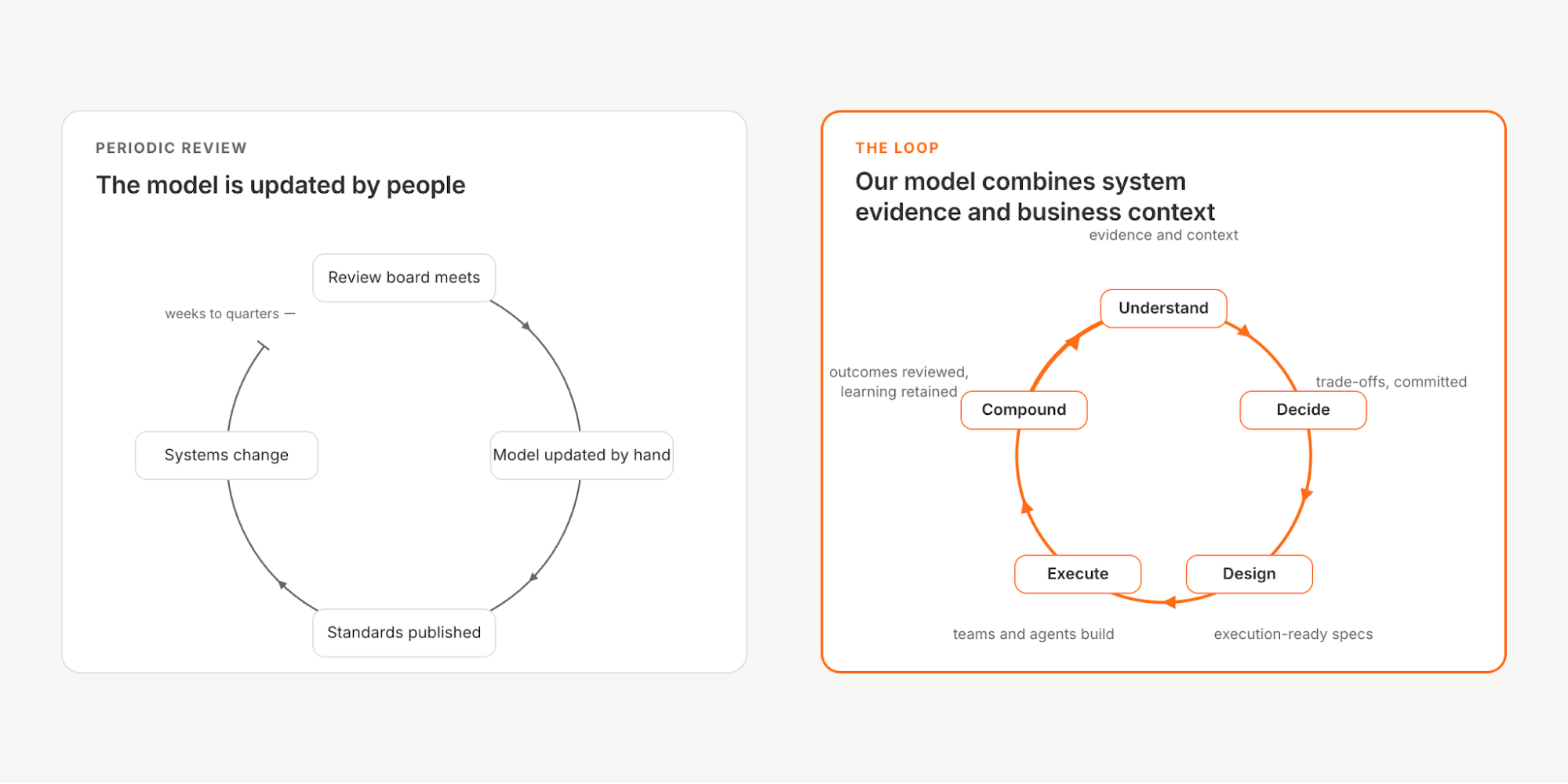
The clock speed is. In practice, most teams run that cycle once a year, and usually for one structural reason: the assess phase is a survey project that takes a quarter, so everything downstream inherits its cadence. Change where the current-state model comes from, and the same activities can run continuously.
We call these five activities Understand, Decide, Design, Execute and Compound. The mechanical difference from the annual version sits in the last one. In a yearly cycle, governance ends the process, and the findings go into a report that informs next year’s assessment. When the loop runs continuously, what governance catches feeds straight back into the current-state model, so the next decision starts with better information than the last. That’s the compounding part, and it’s what makes a practice more accurate over time rather than less.
Common EAM Failure Modes
Most failed EAM practices fail in the same handful of ways.
- Ownership concentrated in too few people: when current-state knowledge lives with three architects, every question routes through them, and the practice becomes a queue. Our answer here is Archie, a reasoning agent that answers questions against the live model of a given workspace and the record of decisions already made against it. Asking doesn’t require booking time with a person.
- Completeness treated as the goal: a model that covers everything shallowly is less useful than one that covers the decision you’re making now in real depth.
- Governance with no teeth at the moment of change: a review board that meets fortnightly cannot govern a system that changes hourly. Exception-based review at the point of change is the version that keeps up.
- Decisions that leave no trace: If the reasoning behind a choice lives only in the meeting where it was made, the practice relitigates the same argument every eighteen months and can’t tell a deliberate reversal from an accident.
- No decisions produced at all: if the output is documents rather than choices somebody acted on, the program will be cut in the next budget round, and it should be.
What to Look for in a Modern EAM Platform
The evaluation criteria that matter have shifted away from repository features and toward how the model stays current.
Ask how current-state data gets in. If the answer is import, upload, or manual modeling, ask who keeps it current and how changes are reconciled. Ask what happens when reality and the model disagree, and whether the tool tells you or waits for you to notice.
Ask whether decisions are first-class objects with a rationale attached. The alternative is a rationale that lives in a Slack thread nobody can reconstruct a year later, when somebody asks why the payments service talks directly to the warehouse database.
Then ask what the output actually is. A structured artifact carries the target state, the gap analysis, and an implementation plan, and a team can build from that. A diagram alone is not an implementation plan, even when the same underlying model generates both.
Test this against a real decision, not a demo dataset. Take something small and recent: a team asks to stand up a third managed Postgres instance when two already exist. A practice that works shows which services connect to the existing clusters before anyone answers, then records why the third was refused. That record surfaces three sprints later, when a new service gets pointed at a fourth instance anyway. A practice that doesn’t work produces a diagram of all four afterward. When you evaluate us, confirm which sources can represent your estate and which evidence still needs to be supplied. An AWS example should not be mistaken for an AWS-only eligibility rule.
For a category-level view of the vendors in this space, including the repository-first incumbents, this enterprise architecture tools roundup compares them against similar criteria.
Conclusion
Enterprise architecture management doesn’t have a framework problem. TOGAF and its peers describe continuous lifecycle management perfectly well, and have for years. What most organizations have is an operating model problem: a practice whose cycle time is set by how long it takes to survey the estate, running against systems that change daily.
The fix isn’t more documentation discipline. It’s changing where the current-state model comes from, so governance, planning, and design all start from something that’s true today rather than something that was true last spring. If your practice spends more time reconstructing what exists than deciding what to build, book a demo to see what the loop looks like when the model maintains itself.
Frequently Asked Questions
What are the four main types of enterprise architecture?
TOGAF’s split is what most people mean by this question: business architecture, data architecture, application architecture, and technology architecture. Other frameworks divide it differently, so treat four as the common shorthand rather than a universal rule. They’re lenses on one estate rather than four separate practices, and problems usually surface at the boundaries between them.
What are the 5 components of enterprise architecture?
There’s no canonical list, which is why answers vary so much. Some sources mean TOGAF’s four domains plus a governance or principles layer. Others are describing one framework’s own five, and those five aren’t always the same five. Use whichever framework your organization has adopted rather than a generic list assembled from search results.
Can an enterprise architect become a CTO?
It’s a common path, though not an automatic one. The architecture side of a CTO role maps directly. The parts that don’t, including hiring, budget ownership, vendor negotiation, and board communication, are where the gap usually sits. Architects who make the move tend to have spent time owning delivery outcomes, not just architectural correctness.
How much does an enterprise architect get paid?
It varies widely by region, industry, and whether the role is hands-on or governance-focused, and any figure published here would be out of date within a year. Live salary aggregators and your national statistics office are better sources for a current number.
Share this Post