August 13, 2026
Event-Driven Architecture: What It Is & How It Works
Somewhere in your system right now, a service is polling another service that has nothing new to say. Multiply that by every integration you run, and you have the case for event-driven architecture: instead of components asking each other for updates, they announce changes as events and let anyone who cares react. EDA powers order processing at e-commerce scale, fraud detection in banking, and much of the real-time infrastructure you interact with daily.
It's also more complex to operate than the diagrams suggest, and it's not the right call for every system. This guide covers what event-driven architecture is, how it works, its core patterns, the trade-offs, and how to decide whether your system should adopt it. It's written for architects and engineering leaders weighing that decision.
What Is Event-Driven Architecture?
Event-driven architecture (EDA) is a software design pattern in which decoupled components communicate by producing and reacting to events, which are records of state changes, rather than calling each other directly. When an order is placed, or a sensor reading crosses a threshold, that fact is published once, and any number of services can respond independently.
An event captures that "something happened": a key, a value, a timestamp, and optional headers/metadata. The event can carry the full state change or just an identifier that consumers use to look up details. Either way, the producer doesn't know or care who's listening. That indifference is the whole trick, and it's what separates EDA from the request-response style that dominates most codebases.
EDA is one of several core system architecture patterns, and it composes with the others: an event-driven system is usually also a distributed one, frequently built from microservices, and occasionally still wrapped around a monolith that emits events at the edges.
How Does Event-Driven Architecture Work?
Every event-driven system has three components:
- Event producers detect a state change and publish an event. They don't wait for a response.
- Event brokers sit between producers and consumers, decoupling them, filtering and routing events to whoever has subscribed. Depending on the product, this middle layer may be implemented as a broker, bus, router, stream/log, or topic-based platform.
- Event consumers subscribe to the events they care about and react: updating a database, triggering a workflow, calling another system.
Terminology shifts across ecosystems, and this can sometimes trip people up as they move from doc to doc: AWS talks about event routers and an event bus; Kafka talks about brokers and topics; Azure splits the role between Event Grid and Event Hubs. The role is the same in each case: the middle layer that lets event producers and event consumers stay ignorant of each other.
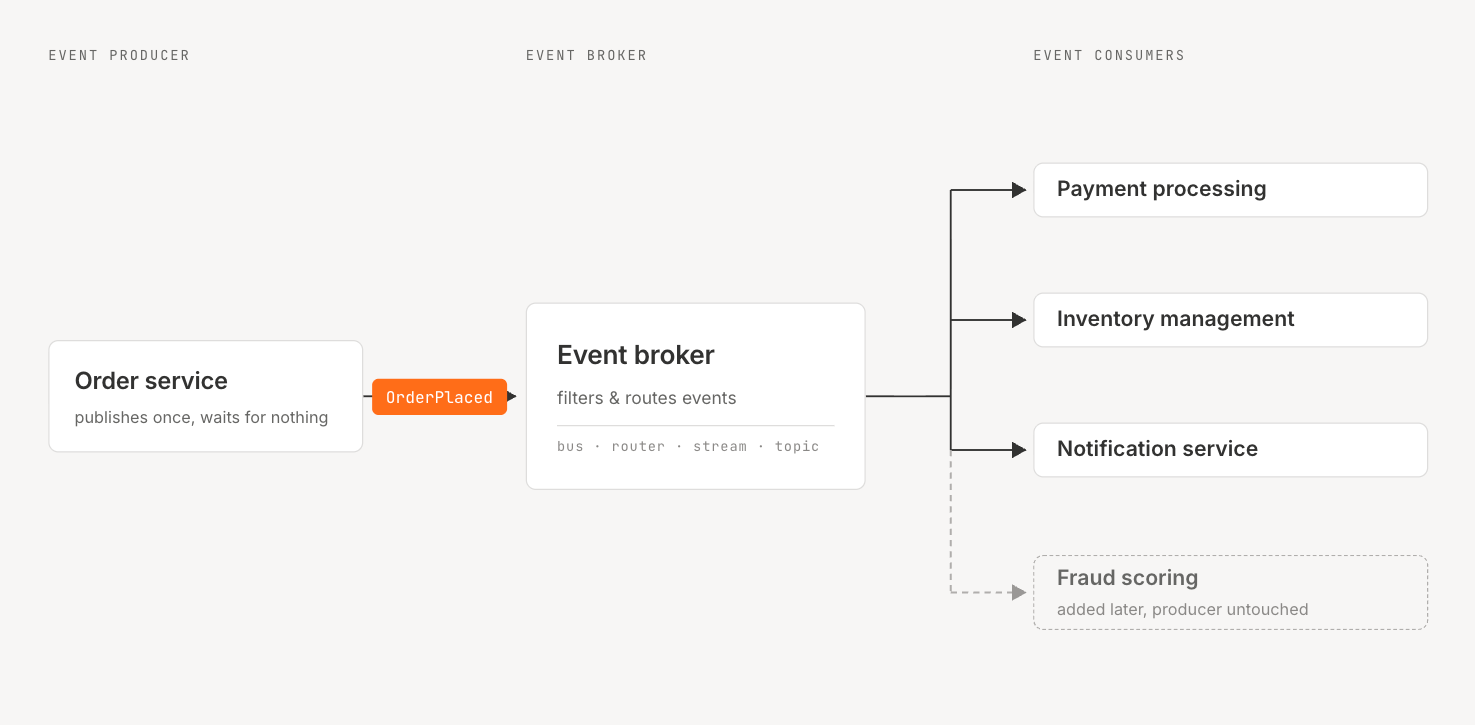
The canonical example is worth walking through because it shows why teams adopt this pattern. A customer places an order. The order service publishes one OrderPlaced event to the broker. Payment processing, inventory management, and the notification service each consume that event independently. Nobody orchestrated four API calls; the order service doesn't even know the notification service exists.
Next quarter, when the fraud team wants to score every new order, they subscribe to the same event stream and ship without touching the order service at all.
Now extend the example past where the textbook stops, because this is where the operational reality lives. What happens when the payment consumer receives OrderPlaced twice, as retries and duplicate deliveries all but guarantee it eventually will? If the consumer isn't idempotent, the customer gets charged twice. What happens when inventory reads its local view a beat before the event arrives? It sees stale stock for a moment, because different parts of the system briefly hold different truths.
Neither is a bug in EDA. Both are properties you sign up for, and we'll come back to them in the challenges section.
Event-Driven Architecture Patterns and Models
"Event-driven" describes a family of patterns, not one design. The three models below cover most production systems, and the topology choice underneath them is the decision most write-ups skip.
Publish-Subscribe (Pub/Sub)
The messaging infrastructure tracks subscriptions and pushes each published event to every subscriber. In a basic, non-durable pub/sub setup, events aren't stored, so a subscriber that joins late never sees what it missed; many production pub/sub systems, however, support durable subscriptions, retention, or replay depending on configuration. Pub/sub is the simplest model and is well-suited to notification-style workloads where only the present matters.
Event Streaming
Events are appended to a durable, ordered log. Consumers read from any point in the stream at their own pace and can replay history, which supports recovery, late-arriving consumers, and reprocessing after a bug fix. This is Apache Kafka's model: events aren't deleted after consumption, and retention is a per-topic configuration you control. Kafka combines publish/subscribe, durable storage, and stream processing in one platform, with Apache Flink as a common companion for stateful stream processing and a schema registry often governing event formats. One nuance that matters at scale: Kafka preserves order within a partition; there is no global order across partitions, and same-key ordering only holds when the partitioner consistently maps that key to the same partition and partition counts and routing are managed carefully.
Event Sourcing and CQRS
Event sourcing stores every change to application state as a sequence of events, so the event log becomes the system of record. In Martin Fowler's canonical 2005 description, the log lets you rebuild state from scratch, query what the state was at any point in time, and replay corrected events. CQRS (Command Query Responsibility Segregation), a pattern Fowler credits to Greg Young, often travels with it: separate models for updating and reading data. Both are capable and sharp. Fowler's own 2011 guidance is that "you should be very cautious about using CQRS," that it adds risky complexity for most systems, and that it belongs in specific bounded contexts rather than across a whole system.
Consumers also differ in how much event processing they do. IBM's guide draws a useful three-step taxonomy: simple event processing, where consumers act on each event as it arrives; event stream processing, where a platform builds pipelines to stream processors; and complex event processing, where consumers analyze a series of events to spot trends, the style behind predictive maintenance and suspicious-activity detection. Most systems start simple and grow into the third category, usually the moment someone asks, "Can we detect this pattern as it happens?"
Broker vs. Mediator Topology
Underneath the models sits a topology decision that Mark Richards formalized in Software Architecture Patterns (O'Reilly, 2015): broker or mediator.
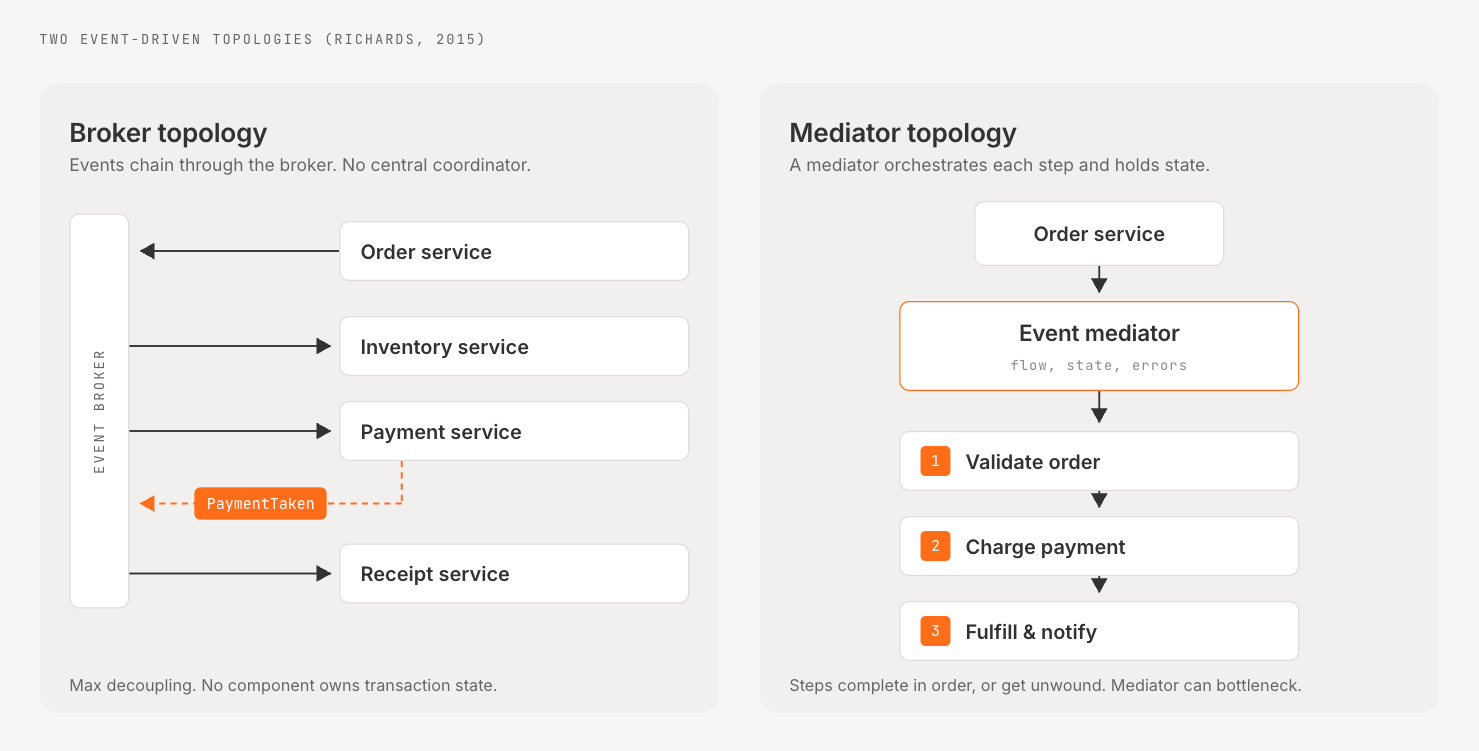
Broker topology chains events through the broker with no central coordinator. It's maximally decoupled, and the cost is that no component owns the state of a multistep business transaction, so error handling and recovery need real care. Mediator topology puts an orchestrator in charge: the mediator manages flow, holds state, handles errors and restarts, and dispatches commands to processing queues. You get control and consistency back, and you pay with tighter coupling and a potential bottleneck. Choose broker topology when events genuinely fan out independently; choose mediator when a workflow has steps that must complete in order, or be unwound.
Event-Driven Architecture vs. Microservices vs. SOA
These three get conflated constantly, partly because most real systems use more than one of them. They answer different questions: SOA and microservices describe how you draw service boundaries; EDA describes how the pieces talk.
The practical relationship: microservices define the units, and EDA is one way to connect them. Confluent's guide draws the same line, distinguishing microservices as an architecture-level paradigm from event-driven programming at the code level, with EDA implemented across both. A microservices system wired together with synchronous REST calls isn't event-driven, and its synchronous call chains couple failure modes under load in ways that event-driven decoupling avoids. SOA's distinguishing habit is the shared contract and often a central bus; EDA's is that nobody agrees to anything except the shape of the event.
Benefits of Event-Driven Architecture
Five benefits consistently appear in production, and each traces back to the same root: producers and consumers interact through events rather than direct API calls.
- Loose coupling and independent scaling. Services scale, deploy, and fail independently. The inventory service redeploying doesn't block orders.
- Real-time responsiveness. Consumers react as events occur rather than on a polling schedule, which is why fraud detection and dynamic pricing gravitate here.
- Fault tolerance. With a durable log or retention-based broker, a crashed consumer restarts and picks up where it left off, though not every EDA broker retains events the same way; broker-level replication is what protects the events themselves from being lost if a single node fails.
- Easier integration across heterogeneous systems. New consumers subscribe without renegotiating contracts with every producer, which is how legacy systems, SaaS tools, and new services end up on the same event backbone.
- Auditability. A retained event stream is a chronological record of what the system did and when, useful for compliance reviews and for the "what actually happened at 2:14 a.m." investigation.
Adoption reflects this. A widely repeated figure holds that 72% of global organizations use EDA; it traces to a 2021 Solace-commissioned survey conducted by Coleman Parkes across 840 respondents in 9 countries, and Confluent's guide repeats the same number. Treat it as a vendor-commissioned signal of ubiquity rather than gospel, but the direction is not in dispute.
Challenges of Event-Driven Architecture
This is the section vendor content underplays, so it gets full weight here. Every one of these challenges is manageable; none of them is optional.
Eventual consistency. Producers fire and forget, so different parts of the system briefly hold different truths. For a recommendation feed, nobody notices. For an account balance, "briefly different truths" is a compliance conversation. If the requirement is immediate, ACID-style consistency across multiple services, a purely event-driven flow may be the wrong fit, though patterns like transactional outbox, sagas, and idempotent consumers can still support reliable business transactions across events.
Event ordering at scale. Preserving global sequence across a distributed system is hard. Log-based platforms give you ordering within a partition, and everything beyond that is your design problem: choosing partition keys so related events stay ordered, and making consumers tolerate the rest.
Idempotency and duplicate handling. Retries and at-least-once delivery mean the same event will eventually arrive twice, and processing it twice must not produce wrong results. Dead-letter queues and retry policies are the standard mitigations, and platform features like exactly-once processing in Apache Kafka reduce, but don't excuse you from thinking about, the problem.
Backpressure and consumer lag. Producers can outrun consumers. Rate limiting, horizontal scaling of consumer groups, and buffering are the levers.
Debugging and observability. In request-response systems, the stack trace tells the story. In EDA, errors surface far downstream from their cause, and tracing one business transaction across async hops requires dedicated tooling and event-flow discipline. Standards help at the margins; CloudEvents, a CNCF specification that graduated in January 2024, gives events a common envelope so at least the metadata is predictable across platforms.
There's a prerequisite challenge underneath all five: you can't design event flows for a system you can't see. Many teams planning an EDA migration are working from architecture diagrams that stopped being true months ago. The gap between the documented system and how your infrastructure actually runs is exactly where migration plans go wrong: a "loosely coupled" service with three undocumented synchronous dependencies will not decouple on schedule.
Real-World Examples and Use Cases
The pattern earns its keep wherever many subsystems must react to the same facts, fast.
- E-commerce order processing. The OrderPlaced fan-out from earlier: payment, inventory, shipping, and notifications react independently, and Black Friday load scales consumers without touching producers.
- Fraud detection. Banks score transaction event streams in real time, correlating patterns across accounts; retained event logs let investigators replay exactly what the system saw.
- IoT sensor data. Fleets of devices produce events at rates request-response ingestion can't absorb; streams buffer, process, and route them.
- Inventory and stock monitoring. Warehouses, storefronts, and forecasting all consume the same stock-level events without polling a database into the ground.
- Notification systems. One domain event fans out to email, push, and in-app channels, each independently retryable.
Two forward-looking notes. First, event streams increasingly feed real-time analytics and ML features, not just operational consumers, which raises the stakes on event schema quality. Second, agentic AI systems raise related coordination questions, a shift we cover in emerging architecture patterns for the AI-native enterprise.
When to Use (and When to Avoid) Event-Driven Architecture
The core heuristic: EDA is a good trade when the coupling you remove costs more than the complexity you add.
Reach for EDA when:
- Multiple subsystems must process the same events
- You need real-time processing with minimal lag
- Producers and consumers need to scale or evolve independently
- You need an audit trail or replay, which a durable event log gives you structurally
Think twice when:
- A workflow needs strict transactional consistency end to end
- Your team hasn't built the observability muscle for async debugging
- The system is small enough that a modular monolith answers every current requirement
- You're adopting it because it's popular, not because a constraint demands it
The same 2021 Solace-commissioned survey found that 71% of organizations believe EDA's benefits outweigh or equal its costs, and that only 13% reach full maturity, with 75% citing inadequate technology as a roadblock. Read those numbers together: adoption is broad, conviction is real, and most migrations still stall somewhere between the first Kafka topic and an organization-wide nervous system.
That stall is usually a decision-quality problem, not a tooling problem, and it's the layer where Catio operates. We aren't an event broker and don't compete with Kafka or EventBridge; we're the decision layer above them. Our Optimize Your Architecture solution generates modernization plans with explicit trade-offs, including event-driven architecture modernization plans grounded in a real-time model of your actual system: the real dependency map, not the diagram from two reorgs ago. Once the direction is set, our Build to Aligned Specs solution generates system-aligned specs so teams can implement the same event contracts instead of inventing their own. The EDA decision deserves that rigor, because it's one of the more expensive architecture bets a team can make in either direction.
Conclusion
Event-driven architecture is a mature pattern with renewed relevance: the components are stable, the platforms are mature, and adoption is wide even discounting vendor-commissioned surveys. It solves real coupling and scalability problems, and it charges real prices in consistency, ordering, and observability. Neither the enthusiasm nor the caution should make the decision for you. Your system's actual constraints should define what must react in real time, what must stay transactional, and what your team can operate at 3 a.m.
If you're weighing an EDA migration, start from an accurate model of the system you have. Our modernization planning turns that model into a decision you can defend, with the trade-offs on the table before you commit spend.
Share this Post