September 15, 2026
Shadow IT: Why Your Architecture Diagram Doesn’t Match Reality

Somebody on the data team spun up a managed Postgres instance eight months ago to hit a deadline. It’s still running, it holds production data, and it appears on no diagram anyone maintains. Nobody did anything wrong, and nobody is hiding it. It simply never made it into the picture.
That visibility gap also makes shadow IT hard to detect. The security literature frames it as a policy problem, which it partly is. But the version that hurts an architecture practice is quieter: systems exist that your model doesn’t know about, so every plan built on that model is built on a partial picture.
This guide covers what shadow IT actually is, why it keeps happening, why the visibility gap matters more than the individual tools, and what to do about it that isn’t a ban. It’s written for CTOs, VPs of Engineering, and architects who own the system of record and keep finding out it’s incomplete.
What Shadow IT Actually Is (And Why the Standard Definition Undersells It)
Shadow IT is technology used in your organization that central IT never sanctioned or never knew about. Bought, built, or enabled by the people who needed it. It covers unsanctioned SaaS subscriptions, personal cloud storage, browser extensions, OAuth-connected apps, and infrastructure spun up outside the standard provisioning path.
The definition is accurate. What undersells the problem is what gets done with it. Notice that it names two conditions, sanction and knowledge, and then look at what the tooling built on it actually does: gate approvals. Approval is a governance state you can enforce at a checkpoint. Knowledge is a state somebody has to maintain continuously, and nothing enforces it.
So the quadrant that goes unaddressed is the one where a system is fully sanctioned, expensed, security-reviewed, and still missing from every diagram you plan against. What that quadrant shares with the unsanctioned one is the part that actually costs you: the model in your hands describes a smaller system than the one you’re running.
Why Shadow IT Keeps Winning
Shadow IT keeps happening because the alternative is slower. A team that needs a tool this week and faces a six-week intake process will find another route, and usually a defensible one. Cloud services made this trivially easy: a corporate card and ten minutes get you a working system that touches production data.
AI has made it faster again. Verizon’s 2026 Data Breach Investigations Report, published in May 2026 on 2025 data, found that frequent AI tool use rose from 15% to 45% of employees in a single year. It separately found that shadow AI, meaning employees using unapproved AI tools, is now the third most common non-malicious data leakage activity. That first number counts tool use rather than undocumented systems, so read it as a proxy, not a measurement of your estate. What it shows is the shape of adoption when the barrier to entry is a browser tab: a tripling inside twelve months, which is faster than an intake process is built to move.
There’s a second reading of the same wave from the organizational side, measured differently and worth keeping separate. A Gartner survey of 302 cybersecurity leaders, fielded between March and May 2025 and published in November, found that 69% of organizations suspect or have evidence that employees are using prohibited public GenAI. The construction doing the work there is suspect or have evidence. Gartner doesn’t split the two, and that is the finding. At 69%, the answer to “is prohibited GenAI running here” is being reported on a scale that runs from an impression to a confirmed inventory. Nothing tells you where on that scale any given organization sits.
The Real Risk Isn’t the Tool. It’s Not Knowing About It.
Security teams frame shadow IT risk as data exposure, compliance gaps, and an expanded attack surface. All real. But those are consequences of one upstream condition: nobody has a current model of the system.
The FinOps Foundation captured this well in its State of FinOps 2026 survey, which covers 1,192 practitioners and more than $83 billion in annual cloud spend. Its summary of the problem: “you can’t automate what you can’t see.” The maturity path it describes is first gain visibility, then build planning discipline, and only then optimize for value. Skip the first step and the other two are guesswork.
For an architecture practice, the downstream costs are specific and unglamorous. Migration scoping misses dependencies that only exist in the undocumented half of the estate. Capacity planning is done against a component list that’s short. Incident response takes longer because the thing that broke isn’t in the diagram. Cost attribution fails quietly, since spend flows through a line item nobody maps to a system.
The compounding one is decisions. A consolidation plan priced against nine services is scoped against the wrong denominator if there are thirteen. It stays that way through approval, scheduling, and delivery, because nothing downstream re-checks the number the plan was built on. The four extra might have made the case stronger. You find out during delivery either way. That’s the difference between shadow IT as a security finding and shadow IT as an architecture problem. The security version shows up as an incident you can point at, and the architecture version shows up as a quarter you can’t account for.
Where Architecture Diagrams and Wikis Fall Short
Diagrams and wikis share one structural property: a person has to update them. That’s the whole problem. Every manually maintained model is accurate on the day it’s written and decays from there, and it decays fastest in exactly the places where things are being created outside the standard path.
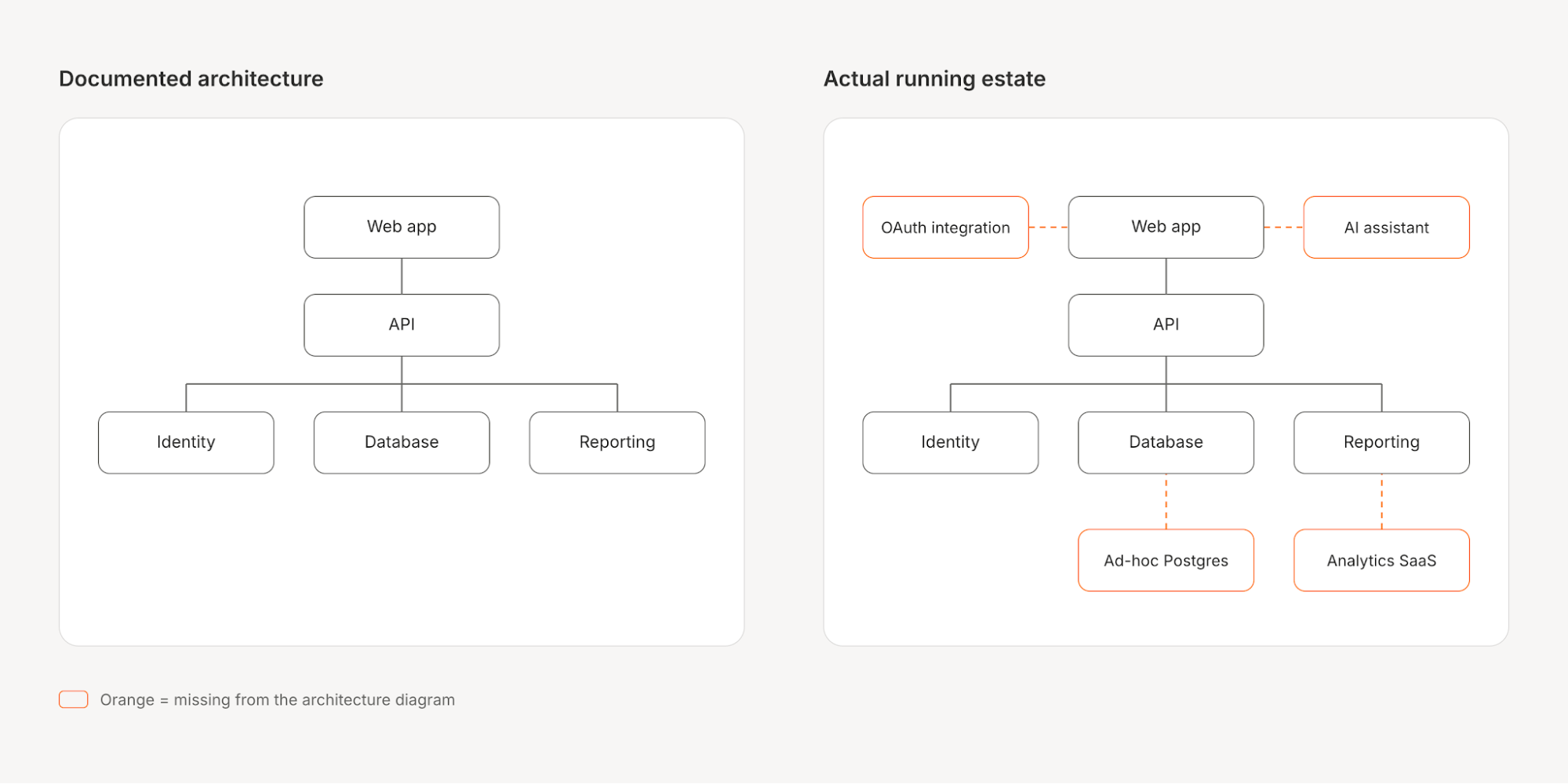
The decay is also asymmetric in a way that makes it worse than it looks. Documentation gets updated when somebody remembers, and people remember when the change is big, planned, and visible. A quarter’s migration gets written up. A Postgres instance created on a Thursday to unblock a report does not. So the systems missing from your model are systematically the unplanned ones, which are also the ones most likely to hold data nobody has mapped and to have no named owner.
The alternative is to derive the model from the environment rather than describe it. That is the approach we took. We connect read-only to infrastructure integrations, such as your AWS accounts, Kubernetes, and VPC flow logs, and we generate the architecture model from what we find, with no manual modeling required.
Supported resources within connected accounts and subscribed scope can appear as integration data is ingested, without somebody declaring each one. Coverage depends on which integrations feed the model, which resource types they support, and what scope you subscribe.
So the limit is real, and it’s wider than the account boundary. Anything outside the connected accounts and the subscribed scope, which is most of the SaaS and vendor layer, needs a different route entirely. Worth saying plainly too: we are a decision and design layer, not an observability tool, and we work with architecture teams beyond AWS-only estates; the available integrations and evidence coverage need to be confirmed for your environment. The failure mode that it creates is quiet rather than loud. A model missing a whole class of systems still answers every question you ask it, and the answers still look right.
What Shadow IT Looks Like in Practice
The examples that matter here are the same ones security decks list. What differs is the consequence you trace them to.
- Services spun up to hit a deadline: a queue, a cache, or a database created outside the provisioning path, still running two years later. The architectural cost is a dependency edge that exists in production and in no dependency map.
- Departmental SaaS: the analytics tool finance bought, which now holds a copy of customer data and syncs to two other systems. Your data-flow diagram is wrong in three places at once, and nobody has a reason to look.
- OAuth-connected applications: third-party apps an individual authorized through your identity provider, holding standing access to mail, calendars, or repositories, with scopes nobody has reviewed and tokens that outlive the person who granted them.
- Duplicate infrastructure after an acquisition: not shadow IT by any definition, since it’s fully sanctioned, but it produces an identical failure. An entire second stack exists on paper and appears in no combined model. It’s the clearest evidence that the problem is documentation rather than permission.
- AI agents and assistants: the category growing fastest from the smallest base. Gartner forecasts that by 2028 the average global Fortune 500 enterprise will run over 150,000 agents, up from fewer than 15 in 2025. That forecast counts all agents rather than unsanctioned ones, and it’s a forecast rather than a measurement. That projected growth would make manual registration difficult to sustain.
A derived model can expose infrastructure or software represented in its connected sources; it cannot establish that unobserved systems do not exist. Reconcile that evidence with finance records, identity-provider records, and endpoint or browser inventories to investigate the remaining SaaS and vendor layer. Otherwise, the omissions can surface as surprises during a modernization assessment, when they are more expensive to address.
How to Get Ahead of Shadow IT (Without Banning It)
Blocking is the reflex, and it doesn’t hold. Max Goss, the Gartner analyst behind that agent-sprawl research, says that “Many organizations resort to blocking or restricting the use of AI agents, but this is not a long-term solution.” The same has been true of every wave before this one.
What works is making the sanctioned path faster than the unsanctioned one, and making discovery continuous so the gap between them stays small.
- Derive the technical inventory rather than surveying it, so new systems appear without anyone filing anything.
- Pull the finance view alongside it. Recurring software spend helps identify paid SaaS that infrastructure discovery can’t see; identity and endpoint records help cover free or unexpensed tools.
- Give provisioning a fast lane: if a team can get a compliant queue in a day, most of them will take it.
- Make registration a byproduct, not a form: anything that requires a human to remember a step will decay at the same rate your diagrams do.
- Review by exception: look at what’s new and unowned, not at everything.
The gap between sanctioned and shadow is a function of how slow the sanctioned path is. Shortening it does more than any policy does.
Turning Shadow IT Into an Architecture Asset
Once a system is discovered, you have a choice. You can treat it as a violation, which teaches people to hide the next one, or you can treat it as new information about the estate you already own.
The second is more useful, and it compounds. Every rediscovery makes the model more complete, and a model that gets more complete each time something is found is a different asset from one that resets every time somebody rebuilds it. That’s the argument for treating discovery as continuous rather than as a project, and it’s the same argument behind keeping your architecture model current generally.
There’s a commercial version of this too. The same FinOps Foundation survey found that 90% of respondents now manage SaaS or plan to within the coming year, up from 65%. That’s a cost discipline expanding its perimeter rather than a shadow IT finding, but it lands in the same place. SaaS is now something organizations formally account for, which means somebody has to enumerate it first. The same survey found that pre-deployment architecture costing is one of the most-requested tool capabilities that commercial tooling hasn’t caught up with. The direction is from accounting for what you found towards deciding before you build, and neither is possible without knowing what’s there. That’s the same input a serious application portfolio management exercise depends on.
Conclusion
Shadow IT is partly a visibility problem; policy alone cannot resolve it. To borrow the FinOps Foundation’s version of it: you can’t govern what you can’t see, and no policy closes that gap if your system of record is a diagram somebody updated eight months ago.
The organizations that handle this well stop trying to prevent every unsanctioned system and start making sure nothing stays invisible for long. If your architecture documentation and your running system have quietly diverged, book a demo to see what a continuously derived model surfaces that a diagram can’t.
Frequently Asked Questions
What does the term “shadow IT” mean?
Shadow IT means technology that’s live inside your organization without central IT having sanctioned it or, often, having heard of it. In practice, that’s unsanctioned SaaS, personal cloud storage, OAuth-connected apps, and infrastructure created outside the standard provisioning path. The distinction worth holding onto is between a system that lacks sanction and one that lacks documentation, because the second breaks architectural planning and it catches sanctioned systems too.
Is shadow IT good or bad?
Both, and the ratio depends on you. Teams adopt tools outside the process because the process is slower than the work, and the result is often a genuine improvement that central IT would have approved anyway. What’s reliably bad is the invisibility, not the tool. A well-chosen system nobody knows about still breaks capacity planning, migration scoping, and incident response.
Why do employees use shadow IT?
Almost always for speed rather than for secrecy. A team facing a multi-week intake process and a deadline this month will find a route around it, and cloud services and AI tools have made that route easier every year. Treating it as a compliance failure misreads the cause. The gap between the sanctioned path and the fast path is what generates shadow IT.
Is shadow IT an insider threat?
Usually not in the deliberate sense, though the frameworks are stricter than that suggests. CISA defines an insider threat as an insider using authorized access, wittingly or unwittingly, to do harm, and classes negligent and accidental insiders as a category of insider threat rather than as something outside it. So shadow IT isn’t excluded on grounds of intent: where an unmanaged system causes exposure, that’s an unintentional insider threat by definition. What’s usually absent is intent, not applicability, which is why the response that works is visibility and a faster sanctioned path rather than an investigation.
Share this Post