September 8, 2026
Business Process Analysis for Architecture Teams

Business process analysis is well documented, and the guides are good, but they end in the same place. You finish with a validated map of how the work runs today. You then hand the map off as an automation backlog, a requirements document, or an improvement plan in a deck.
Almost none of them check that map against the system that actually executes it. An automated process step can involve a form submission that hits a service, a nightly job that moves a file, or a queue that nobody has looked at since 2023. This piece covers the discipline the normal way first, then what the process map tells you about your architecture.
What Is Business Process Analysis?
Business process analysis is the structured examination of one business process, end to end, to understand how it runs today, where it loses time or accuracy, and what should change. It produces an as-is process map with owners, handoffs, decision points, and exception paths, plus a prioritized set of changes.
Two things separate it from adjacent work: it is scoped to one process rather than a department or a strategy, and it is descriptive before prescriptive. The map of what happens now comes first, and it surprises people: processes accumulate workarounds the way systems accumulate services. Nobody documented the step where the ops lead re-keys an order into a second tool, and it is still in the process.
Why Business Process Analysis Matters Before You Touch the Architecture
Three reasons, none of them documentation for its own sake.
A system change lands on people. A correctly instrumented trace can show the recorded services and sequence for a sampled request. Gaps in instrumentation, propagation, or sampling can hide parts of the path. Even a complete trace says nothing about who is waiting at each step, which handoffs happen in a spreadsheet, or which ones a human re-keys.
The process names the constraint you are about to design against. Cycle-time targets, the step the business treats as load-bearing, the exception path carrying a third of the volume. Those decisions determine whether a proposed architecture is an improvement or just a different diagram.
Sequencing. Automating a step before you understand why it exists is how a reconciliation job gets built to paper over two systems that disagree about what a customer is.
Business Process Analysis vs. Business Analysis vs. Business Architecture
The comparison usually offered is two-way, between process analysis and business analysis, which leaves out the term a technical reader is most likely to collide with.
The IIBA defines business analysis around enabling change by identifying needs and recommending solutions that create stakeholder value. Process analysis is one technique inside that practice, not a smaller version of it.
Business architecture sits at a different altitude, working in capabilities and value streams rather than steps. Our guide to business architecture covers that layer, including why a capability map stays stable while the processes underneath change constantly.
The Steps of a Business Process Analysis
Sources number this differently; the sequence underneath is stable.
1. Pick One Process and Define What Better Means
Scope is the whole game. “Improve onboarding” is not a process; “from signed contract to first successful API call” is. Name the trigger, name the end state, and write down the measure you are trying to move before mapping. An analysis without a target metric turns into documentation for its own sake. Pick the process where the pain is loudest, not the one easiest to map.
2. Map the As-Is Process, Including the Exception Paths
Sit with the people who do the work and walk the process step by step. For each step, capture the actor, the trigger, the system touched, the output, and the wait before the next step. Swimlanes are the usual notation: the bands make handoffs impossible to hide.
The exception paths are the part teams skip and the part that matters most. Every process has a happy path, plus branches for when a payment fails, a record is a duplicate, or the customer sits in a jurisdiction the form does not handle. That is where the manual work lives, and where system boundaries get crossed in ways the architecture never anticipated.
3. Gather Data and Find the Root Cause
Now attach numbers: cycle time per step, wait time between steps, volume, error and rework rates. A step that takes four minutes and runs twice a day may not be the largest time cost, even if it dominates the interviews. Error impact and risk also matter; perceived pain and measured cost are different measures. Then work backward from the worst offenders to a cause, without treating a symptom as a cause and rebuilding around it.
4. Decide What Changes, and Record What the Process Touches
Sort the findings into what you fix in the process, what you fix in the tooling, and what you accept. Then do the step that gets skipped: record every system, service, and data store the process crosses, with the owner of each.
Business Process Analysis Techniques and Tools
A short toolkit covers most of what you need.
- Swimlane diagrams for the as-is map, when the question is who does what and where handoffs are.
- Value stream mapping, in the Lean sense rather than the business-architecture sense, when the question is where time goes. The Lean Enterprise Institute defines it as “diagramming every step involved in the material and information flows needed to bring a product from order to delivery”. It puts wait time and work time in one picture.
- Fishbone diagrams for cause analysis. ASQ describes the fishbone, also called an Ishikawa diagram, as “a quality tool that helps users identify the many possible causes for a problem by sorting ideas into useful categories”.
- The five whys when the causal chain is short, and you need to stop the team from settling on the first plausible answer.
- Process mining when the process runs inside systems that log it: event logs can reveal discrepancies with interviews, which are worth investigating.
Process mapping tools and enterprise architecture tooling solve different problems; neither does the other’s job.
Mining and drafting tools increasingly propose the causal story rather than only rendering the event log, which still leaves somebody accountable for the judgment. Agents are also starting to execute steps rather than describe them, which makes the boundary explicit: what an agent may read, and what it may do. The Model Context Protocol specification states the principle: “Users must retain control over what data is shared and what actions are taken,” while noting it cannot enforce that at the protocol level. If an agent performs a step in your as-is map, map it as a step with an owner.
Where the Process Map Stops and the Architecture Question Starts
In the guides we have read, the map ends at one of three handoffs: an automation backlog, a specification a developer can build against, or an improvement plan.
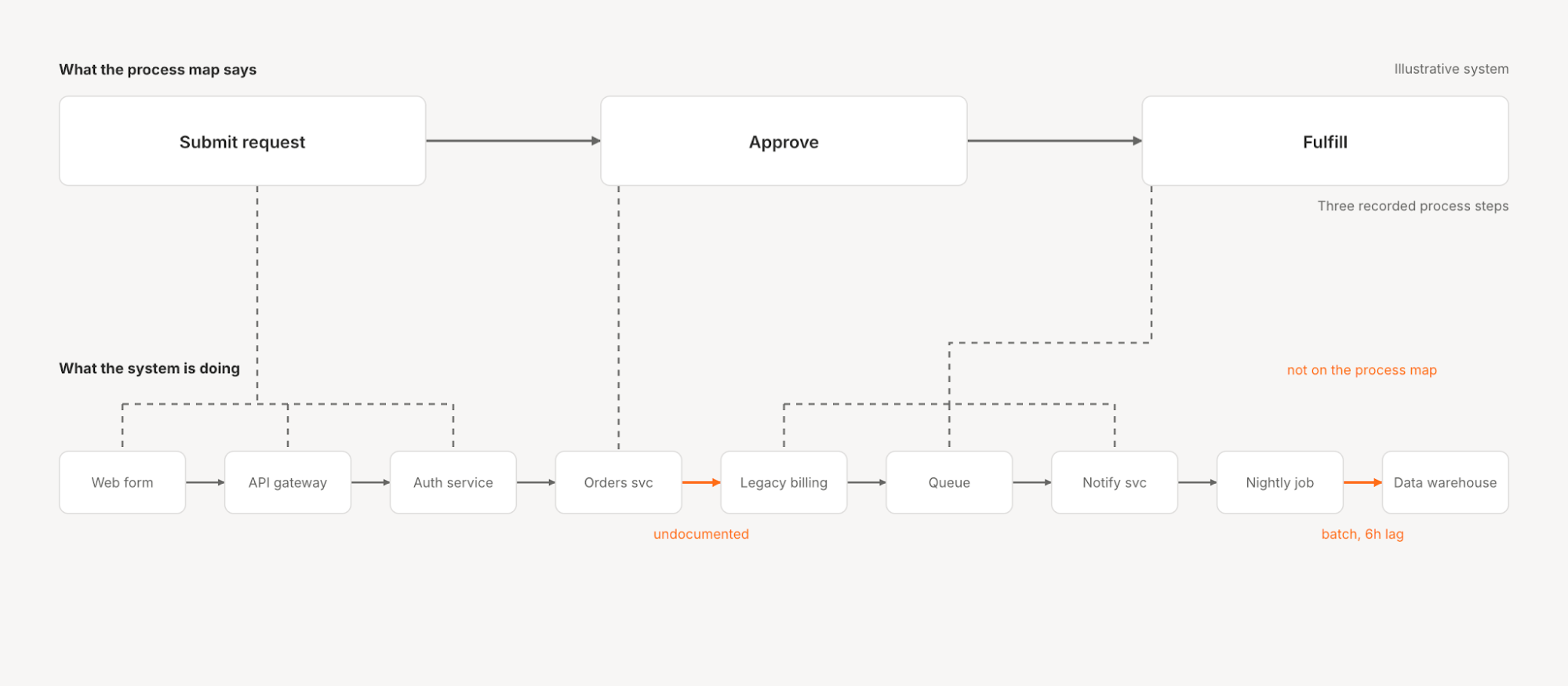
Those handoffs do not automatically reconcile the map with the running system. An as-is process map records the team’s understanding of current work, and that record can diverge from implementation.
Three questions make the gap concrete. First, for each system the map names, is that still the system doing the work? Second, where the map shows one step, how many services are involved, and does the step’s owner know that? Third, where the map shows a handoff between two teams, does the system architecture have a matching boundary, or is one team writing directly into the other’s database?
That third one is the expensive one. A process handoff without a matching system boundary is how a change to one team’s process breaks another team’s service, and an interview-derived map will not surface it. Process mining gets closer and is bounded by the event data extracted, so a direct write or a side path stays invisible when it produces no event. Reconcile the event log against telemetry, configuration, and source.
Turning a Business Process Analysis Into Architecture-Ready Input
If the analysis is to feed an architecture decision, carry five things forward and drop the rest:
- The systems touched, per step, named specifically rather than as “the CRM”, including the APIs and endpoints crossed
- The owner of each step and each system, often different people, which is frequently the finding
- The data that moves between steps, including what gets re-keyed by hand
- The exception paths, where the undocumented integrations live
- The service expectations, as measurable SLAs or SLOs where they exist, and as the business’s stated belief about what the process guarantees where they do not
Two of those five are things a good architecture model already holds: the systems touched, and the data moving between them are architecture state, and in our model nobody types that in. A system-derived model does not supply the business intent, ownership, and service expectations the analysis captured. Those you write down.
Context has three layers: the objective (business and product context); the constraints (the architecture state model); and the steering (standards and the paths the organization has ruled out). Two of those three you write. The middle one arrives on its own, live from your integrations, which is the part a process analysis cannot hand you.
The constraint layer is built from code and cloud configuration rather than recollection, the piece a process analysis cannot produce and consistently needs. We built Stacks as that layer rather than as a diagramming tool, derived from the integrations you connect, which are read-only, so coverage is bounded by what you connect.
We connect business context with software and infrastructure evidence so you can investigate whether a process still matches the systems supporting it. That complements process mining, interviews, and swimlane analysis. This gives your team easy access to validate budget, organizational complexity, and strategic benefit rather than expecting infrastructure evidence to establish them.
Conclusion
A business process analysis is finished when you know how the work runs, what it costs, and what should change. It stays useful while that knowledge is still connected to the systems doing the work. That connection decays fastest, because processes and systems drift on different schedules and nobody owns the join.
So do the analysis properly, then write down what it touches. The list of systems, owners, data flows, and exception paths is worth more six months from now than the improvement plan. An IT architecture conversation would otherwise reconstruct it from memory.
If you want the other half of that picture, book a walkthrough and bring the process you just mapped. The interesting part is usually the gap between what the map says the system does and what it is doing.
Frequently Asked Questions
What are the three types of BPM?
The split you see most often groups business process management by what the process centers on: human-centric, integration-centric, and document-centric. Treat it as shorthand rather than a standard, since no standards body defines the categories.
Can business analysis be replaced by AI?
Not the part that matters. The mechanical work, collating notes, drafting documentation, and spotting patterns in event logs, is well suited to it. The rest is deciding which process to analyze, getting a room of people with conflicting incentives to agree on what actually happens, and judging which findings the organization will act on.
What are the 7 stages of business analysis?
Vendor lists range from four stages to nine, and the IIBA does not publish a numbered sequence at all: its standard frames the work through core concepts rather than stages. Treat any fixed count as one author’s framing. The stages most versions share:
- Understand the business need
- Define scope
- Elicit and analyze requirements
- Evaluate options and recommend a solution
- Support implementation and validate the result against the original need
What are the 5 core business processes?
There is no universal list of five. Define core, support, and management processes for your own organization. Core processes deliver value directly to a customer, supporting processes cover work such as hiring or procurement, and management processes cover planning and governance.
Share this Post